|
Sandra's Swiss Diary 2007
If you want to
see the photo report of my second trip to Europe,
please click here.
I
guess not a few of my nearest and dearest
friends and family thought this Flatlander-fear-of-flying
lady-journalist would never make the journey
across the Pond. Well here I am! Must
say, I too had my doubts and fear to conquer
as I boarded the Swiss Airlines Airbus in
Chicago on April 3rd, 2007. My son Forrest
and I had driven from Suttons Bay hours
earlier, making a mad dash down to O’Hare
to be sure I made the flight in plenty of
time. (Ok Joerg and Cathy, see? I did!).
Several
years in advance, one of my closest chums,
Suzan Moody (who just about had to kick
me aboard that tiny plane), and I took a
flight in a single engine plane, leaving
Woolsey Airport in Northport and flying
ever so silently above the Leelanau’s mesmerizing
scenery. This flight was to show me there
is nothing to fear about flying but fear
itself…ok, sure!
From
the Midwest to the Alps - April
3 / 4, 2007
Well,
my flight over the Atlantic was anything
but quiet and peaceful and was instead pretty
tumultuous, to say the least. I sat buckled
in for nine hours straight, paralyzed in
my own fear and no, the plane`s tail did
not fall off (surely I thought it
would with all the vibrations and sounds
of the heavy winds). At dinner, not too
long after take-off, the captain told us
we were going to have to descend 1,000 feet
so the flight attendants could serve dinner
without the dishes being thrown all about
us.
Some
nine plus hours later, the captain informed
us over the loudspeaker that the northwest
winds would make our landing in Zurich a
bit rough - it was! And the
funniest thing of all was the head stewardess
giving me a bottle of champagne she said
for me to share with Joerg in the Alps,
for she said she knew how frightened I was
and congratulated me for making the crossing
so well…
Joerg
picked me up at Zurich Airport and took
me to his family's vacation home, an almost
400 year old farm house in the Engadine
Valley at 4500 ft above sea level.
I
was quite exhausted from the long, tumultous
journey overseas, then coupled with a three
hour drive through mountainous areas I was
quite unaccustomed to.. By the time we got
to the Engadine Valley my brain seemed to
register everything as nearly sideways,
my head seemingly gravitating to the floor.
But even in my exhausted state the beauty
surrounding me was unparalleled.
Marietta,
the lovely lady next door, kindly took me
by the hand. Although she is about 30 years
older than I, she had to support me for
guiding me into her home to serve me tea
and cookies while Joerg was tending to the
business of heating up the house.
|
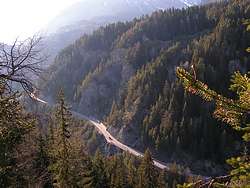
This
is the kind of roads on which Joerg took
this
Flatlander to the Engadine -
not exactly soothing
after a
pretty rough flight across the Atlantic.
|
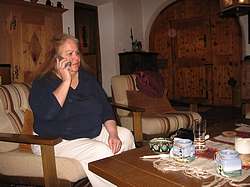
Of course, calling home was my
first action after arriving
in Tarasp,
a sweet little village in the Lower Engadine
Valley.
|
First
week: Engadine, Grisons
Two
days later my first ever bout of jet lag
was more or less over. Walking upright was
again feasible according to my mental process.....
Simply
put, Switzerland is utterly beautiful. Thus
far I have traveled up into the Alps, where
I'm spending my first week in the Rothenberger
family vacation home, built circa 1616,
in Valatscha, a tiny village of only 10
very old farm houses about an hour from
St. Moritz. The peaceful beauty there is
indescribable.
|
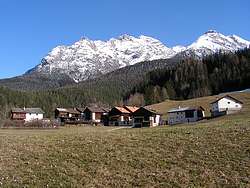
Valatscha and
the Pisoc Range, part of the Swiss Alpine
National Park.In this area of Switzerland,
farm houses always
group in little
villages, with the front side to the main
street and
the barn on the back side.
|
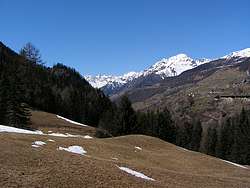
Looking west, i.e. up the valley from Valatscha.
Most of the
mountain peaks are more
than 14,000 ft above sea level.
|
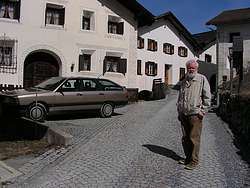
Joerg in front of the family's vacation
home (left).The stone
walls are about
3 ft thick to withstand the assaults of
the
elements, especially in winter.
|
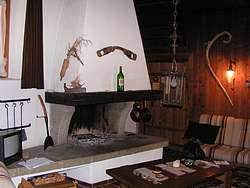
The fireplace in the large living
room, designed by
Joerg in 1973.
|
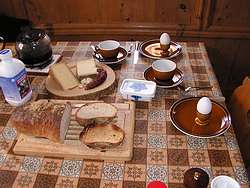
Breakfast, Grisons style.
|
We
had most of our meals in the dining room
with its handsome, almost 400 year old paneling
walls. In former centuries the room
was a meeting place of sorts for the community
to gather. Mornings the women of Valatscha
would meet for spinning and exchanging chat,
evenings often the men would meet to discuss
the likes of business and other matters
along with news of the day.
|
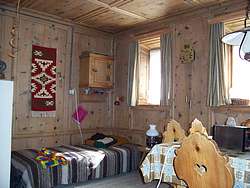
The dining room, still pretty much
the same as it was
almost 400 years
ago.
|
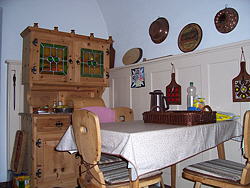
Another dining table in he vaulted
kitchen.
|
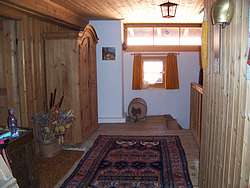
The hallway on the upper floor, where the
bedrooms are.
Some of the furniture
is even older than the house!
|
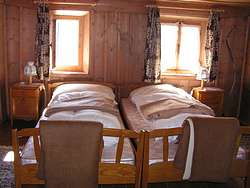
One of
the bedrooms, again one with paneling from
the 17th
century.
|
Our
daily Alpine walks shall always be among
the most memorable in my life. The sheer
beauty and peaceful atmosphere of the Alps
beckoned me as if I were a long-lost daughter
and now I was home at last. Yes, Valatscha,
one of the ten settlements in the Romansh
speaking community of Tarasp, where traces
of human dwellings date back to the Bronze
Age (about 3500 years ago), feels like home
to me.
Romansh
is one of Switzerland's four national languages,
the native language of only about 50,000
people. In the Lower Engadine, people speak
Vallader, one of the five dialects, which
differ enough to make it difficult for people
from different Romansh areas to understand
each other.
By
the way, the general Vallader greeting is
"Allegra," which just means, "Rejoice"
or "Be happy," a truly nice way
of saying Hello.
|
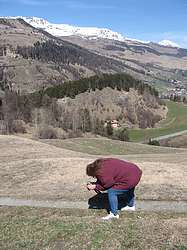
Oh no, not what you may think... I'm
shooting a
photo of a spring flower
next to the foot path.
In early April,
there ought to be three or four feet
of snow at this elevation, but there was
none. |
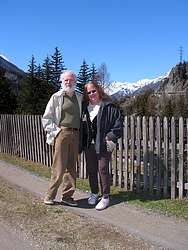
Joerg and I in Aschera, the smallest
of the settlements
in Tarasp, with
no year-round residents. The dirt road ends
here, and only hikers can go further
up the valley over a
suspension bridge
for pedestrians only.
|
One
early afternoon Joerg and I took a three
hour trek up the Mottana mountain, with
views over the little towns far below. Upon
descent we encountered knee high “corn snow”
where I found it necessary to grab a long
stick to utilize my safely venturing down
the sometimes icy parts.
|
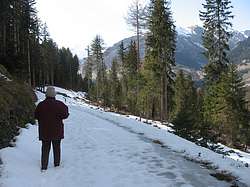
Some snow and ice, a mere shadow of what
ought to lie
here at this time of the
year. However, I refused to walk
on
the easy side of the narrow road, because
I feared
falling down what I called
the cliffs, which gave Joerg
quite
a laughing fit.
|
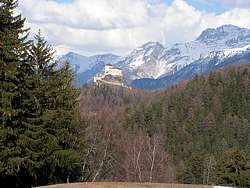
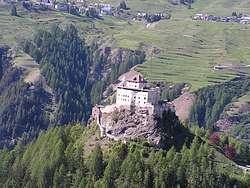
Tarasp Castle on its hill dominating
the whole valley, seen
from the west.
Views of this kind made me forget the perils
I saw on all the steep slopes seasoned
mountain goats like
Joerg do not even
notice. |
One
afternoon we had a particularly special
time in Sparsels, which is another settlement
of Tarasp about two miles from Valatscha.
Surrounded by towering, snow capped
mountains, Schloss (Castle) Tarasp
takes central stage.
|
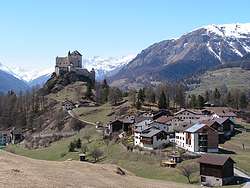
Tarasp Castle and Sparsels. The keep
and other important
parts were built
about 900 years ago. After the Middle
Ages, the castle was left to decay. In the
early 20th
century it was restored
and now is a museum.
|
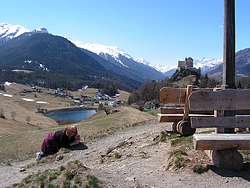
Now this
is
what it looks like: me crawling on the top
of Mot
da la Crusch (Romansh for "Cross
Hill"). Joerg said moms
push their
baby buggies up there, but I was so afraid
of
the height I couldn't even stand
on my feet. The view was
worth the
risk, though - downright breathtaking.
|
At
the little central square in Sparsel, nearly
under the shadow of the castle, Joerg told
me that one of the typical old farm houses
next to the square actually is what he called
"possibly the smallest high class hotel
in Europe, if not in the entire world."
The Hotel Chastè (which simply means
"castle" in Romansh) is known
way beyond the neighboring countries.
Sure
enough, Rudolf Pazeller, the owner, an old
friend of the Rothenbergers, and his wife,
Daniela, asked us to come in. Rudolf insisted on taking
us on a personal tour throughout the hotel
with explanations along the way about the
decade-long restoration process. “This place is like a child to
me,” he said.
The hotel is situated
on what was once the Pazeller farm and has
been in the family for more than 500 years
- now twenty-one generations! My imagination fuelled by the
romanticism all about me was fired by thoughts
of people long before my very own footsteps
now walking these so impeccably kept rooms.
Rudolf
is not only a very committed hotel owner
but also a highly praised chef de cuisine
and culinary artist. In 1971 he headed the
team that tended the huge cold buffet for
thousands of guests at the 2500th anniversary
celebration of the Persian Empire in Persepolis,
Iran. Later he came back to Tarasp to take
care of the family restaurant his grandfather
Anton Pazeller had founded in 1912. |
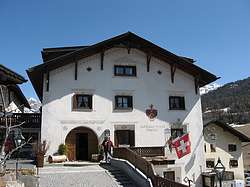
The front side of Rudolf Pazeller's Hotel
Chastè in Sparsels. |
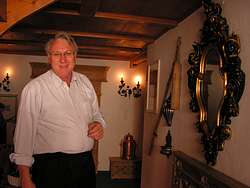
Rudolf Pazeller kindly giving us a
tour of his hotel.
|
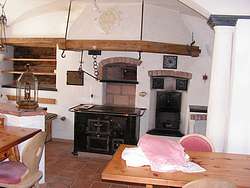
The old kitchen in the Hotel Chastè,
not in regular use any more.
|
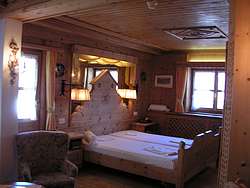
One of the suites, every detail hand-crafted.
|
Seemingly
too soon it was time to leave Tarasp. The
drive back below was awesome. I found,
even while driving, some photos could be
shot from the car even at fairly high speed
and actually turn out without so much as
a blur - “photos on the fly” became my newly-coined
phrase with laughter in between each word.
We
travelled through the tiny villages of the
Engadine instead of taking the car shuttle
train back through the 12 mile long Vereina
Tunnel, the second longest narrow gauge
railroad tunnel in the world; only the Furka
Tunnel on the same RR network is slightly
longer.
Each
village we saw had their own charm, and
next time perhaps we will have more time
to wander each and explore. But now
we were in a hurry to get down to Walensdadt,
Joerg had patients waiting soon! I
was very grateful he took extra time to
take me the long way back so I could experience
these sites even though “on the fly”!
St.
Moritz, surely one of the rizziest skiing
resorts on this planet, was more or less
at the halfway point of our trip down. On
the southern ramp of the Julia Pass, we
made a short stop to take in the view over
the scenic lakes of Silvaplana, where the
Engadine Ski Marathon is held annually,
with around 15,000 participants sure one
of the biggest cross-country skiing events
world-wide.
The
curves and heights through the 7500
ft elevation Julia Pass could
have stopped me from breathing but I was
too busy looking at the beauty all around
and trying to shoot photos with some semblance
of structure and composure.
From
a way too early hint of alpine spring we
drove down into a full-blown lowland spring,
a month too early also there, and that,
as Joerg told me, after a winter that was
the warmest ever since weather records have
been systematically documented. The last
twenty years have brought more weather records
to Europe than the 200 years before.
|
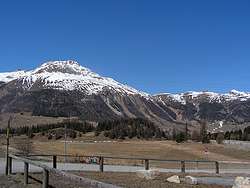
Entering the Upper Engadine east
of St. Moritz, where the
bottom of
the valley is about 6000 feet above sea
level.
|
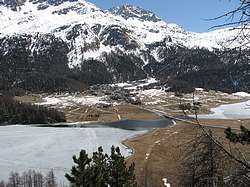
The lakes on the Silvaplana Plateau
just west of St. Moritz. |
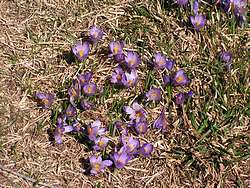
There ought to be at least 5 feet of
snow at this altitude
of 6800 feet
in early April. Instead there are crocuses.
|
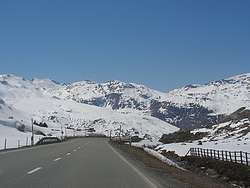
On the Julia Pass road, 7500 feet high,
heading northwest
to the Central Grisons.
|
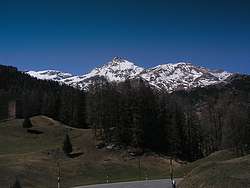
Below the snow line again. Here spring
is already in full swing.
|
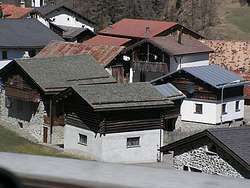
Completely different architecture,
much more wood, not
only on the barns.
|
Second
week: Walenstadt, Heidiland
Now
we are in Walenstadt, a part of Heidiland.
Heidi was one of my favorite
books as a young girl. I could almost taste
the Grandfather’s bread and cheese, hear
Peter’s goats, and feel Heidi’s every joy.
Now here I am soon to tour Heidiland and
even write an article on this wonderful
area for the Traverse
City Record-Eagle. It feels like a dream come true. Conversely, as a
young boy of five, Joerg wrote a tiny booklet
along with pictures, of his recollection
of Heidi the movie. We stumbled on the booklet
while unpacking some of his late parents'
boxes now stored here at his practice in
Walenstadt.
Walenstadt
has about 4,500 inhabitants. It's situated
in the Seez Valley, which connects the Zurich
area with the Grison mountains. The Autobahn
(Expressway) to Zurich (northwest) and the
Grisons (Southeast) is less than a mile
away, and there are express train stops
for both directions at the RR station at
least once an hour. A dense network of busses
connects the town to the neighboring towns
and villages. In Switzerland, you can easily
live without a car and still reach every
place in a reasonable time and at an acceptable
fare.
The
town is beautiful, all the streets sided
with homes with carefully tended gardens.
Spring blooms are everywhere. Most of all
I am amazed at the tulips, so large and
in so many colorful hues, and that in the
first half of April, 1400 ft above sea level
and at a latitude equal to mid Lake Superior.
|
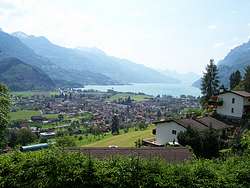
Walenstadt and the lake, looking westward.
|
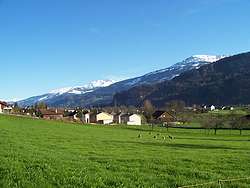
Looking up the valley, i.e. southeast.
|
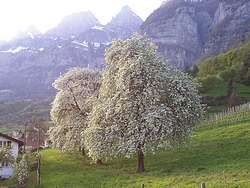
Apple trees were in full bloom already
in early April.
|
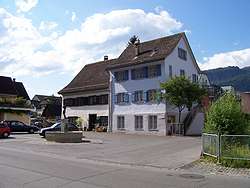
One of the little squares in the old
town center. The left
building is about
350 years old, the one on the right was
built in the eighties. |
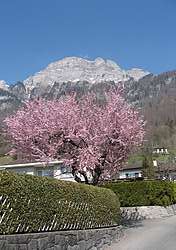
A blooming Chinese cherry tree.
|
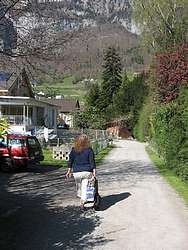
On the way home after shopping.
|
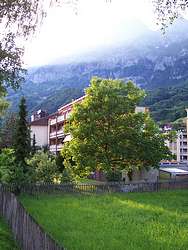
The building on Lake Street where Joerg's
practice is.
|
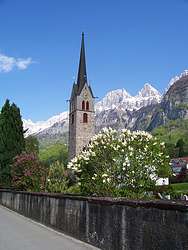
The Catholic Church, the oldest parts
of which are
about 900 years old.
|
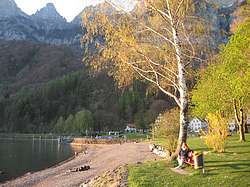
Enjoying the evening sun on a park
bench next to the little
harbor.
|
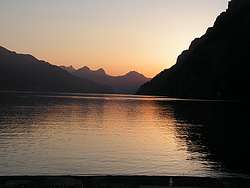
Sunset behind the lake, which
is about the same size as
South and
North Lake Leelenau put together.
|
A trip
up to Walenstadtberg above Walenstadt on
Sunday confirmed I am a Flatlander. The
narrow, winding, hair pin turns, often without
guard rails, strike terror in me. But
the beauty seen so high up is surely a reward.
|
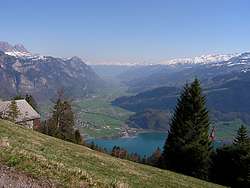
The eastern tip of the lake and the
upper Seez Valley,
looking southeast
from Walenstadtberg, elevation 4,500 ft.
|
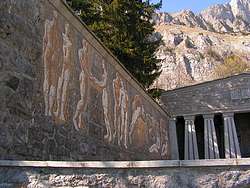
The Pax Mal (Peace Monument), a unique
place of
contemplation built and adorned
with big mosaic murals by
one single
man, Karl Bickel Sr. (1886 - 1982). To shoot
a
photo of the entire monument, you
need either a fish-eye
lens or a helicopter.
|
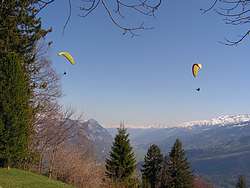
The mountain range north of Walenstadt
is a paradise
for paragliders.
|
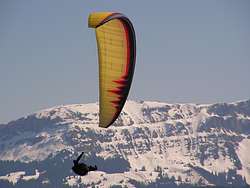
Some of those guys can catch an up-hill
wind so they can
keep their elevation
for hours.
|
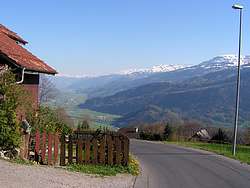
Road in Walenstadtberg. I hate those
hairpin bends but I
love the view and
the peaceful atmosphere.
|
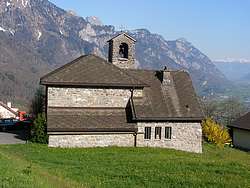
The church in Walenstadtberg.
|
Third
week: St. Gallen City area, Appenzell
On
Saturday we toured the tiny country of Liechtenstein,
one of the smallest countries in the world,
on our way to see Joerg’s brother Richard,
his wife Brigitte, and sons Toby and Benny
for the weekend Their home is lovely,
a former farm house somewhere around 300
years old. On many walls are displayed pieces
of Richard’s excellent art work.
|
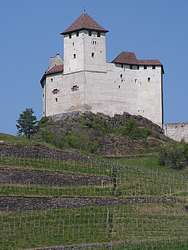
Gutenberg Castle in Balzers, Liechtenstein.
|
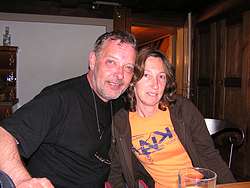
Richard, Joerg's brother, and Brigitte,
his wife. |
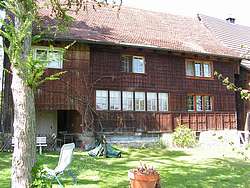
Their home in Roggwil, a little town
near Lake Constance
in the north-eastern
corner of Switzerland.
|
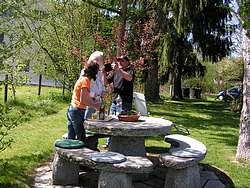
Preparations for an outdoor dinner
in their back yard.
|
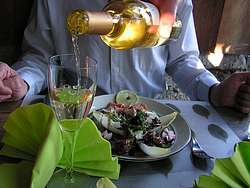
Both Richard and Brigitte are great
cooks, and being
entertained by them
is a treat.
|
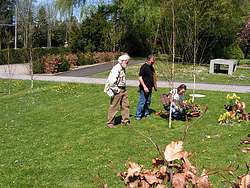
We visited
the grave of the mother of Richard and Joerg
in St. Gallen. She died in January.
|
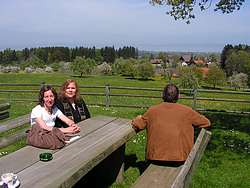
On the
way back to Roggwil, we wetted our whistles
at
a farmers' and hikers' watering
hole on a hill, with a pretty
badly
organized waitress but a gorgeous view over
Lake
Constance including the German
shore and hills on the
other side of
the lake.
|
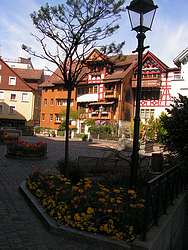
The Fish
Market Square in Arbon, a 2000 year old
town on Lake Constance. |
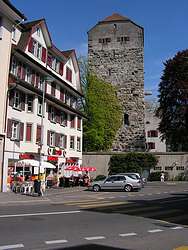
Arbon Castle
on the little hill where there was
a
watchtower already in Roman times. |
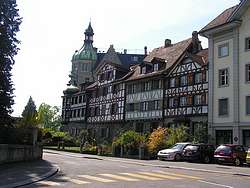
Timberframe houses in downtown
Arbon, pretty typical in
this area.
|
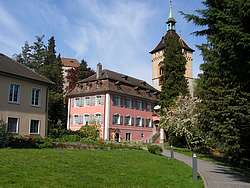
The old parsonage in Arbon. |
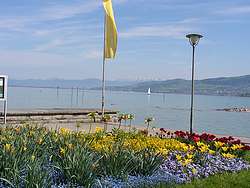
Spring flowers galore in the waterfront
park next to the
harbor. The hills
in the left half of the background belong
to Austria.
|
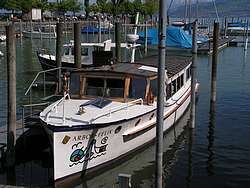
The Arbor
Felix,
a pretty old tourist boat, still going strong.
It is named after the old Latin name
of the town.
|
Monday,
on the way back home to Walenstadt, Joerg
gave me a tour of his late father’s company
in St. Gallen, now run by Richard. (Please
if you wish visit www.rothenberger.ch). We then
took a short bus ride - busses are run by
overhead tracks - to walk around the downtown
district and view the Cathedral.
The monasterial district of the city, founded
612 AD by Saint Gallus, a missionary monk
from Ireland, is on the UNESCO list of World
Cultural Heritage.
Here
is what the UNESCO list says: "The
Convent of St Gallen, a perfect example
of a great Carolingian monastery, was, from
the 8th century to its secularization in
1805, one of the most important in Europe.
Its library is one of the richest and oldest
in the world and contains precious manuscripts
such as the earliest-known architectural
plan drawn on parchment. From 1755 to 1768,
the conventual area was rebuilt in Baroque
style. The cathedral and the library are
the main features of this remarkable architectural
complex, reflecting 12 centuries of continuous
activity."
|
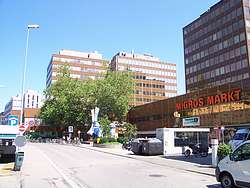
St. Gallen was one of Europe's most
important cultural
centers in the early
Middle Ages. Culture is still important,
but so is business.
|
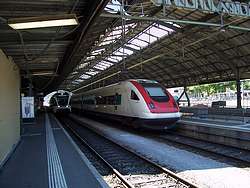
Railroad lines in six directions
with several trains per hour
in each
direction make traveling easy and comfortable.
|
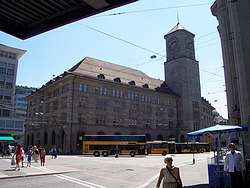
Main Station Square with the central
post office.
Busses everywhere. 14
bus lines are present on
this square.
|
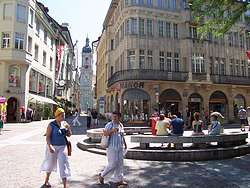
The medieval center of the city
east of the business
district is just
as busy, with all sorts of stores, restaurants
offices etc..
|
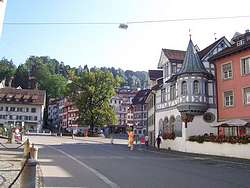
Gallus Square west of the cathedral
takes you back
several centuries.
|
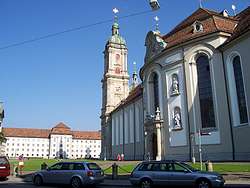
The cathedral, finished 1768,
the newest in a row of many
cathedrals
built in exactly the same place.
|
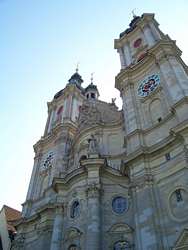
The steeples of the cathedral.
|
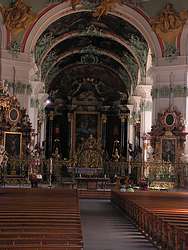
The very rich interior of the
cathedral.
|
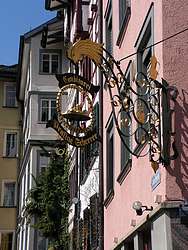
Many businesses have such ornamental
forged
signs.
|
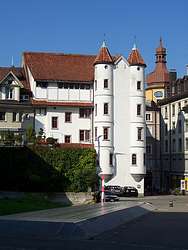
Restaurant "Schlössli"
("Little Castle"), built
around 1520.
|
After
a lovely authentically Italian lunch in
a restaurant close to Richard's office,
we said our byes to Richard and his crew.
We journeyed the side roads back to Walenstadt. There
are so many little towns, most of them pretty
close to each other, and each of them have
their own special flavor. A stop in Appenzell
was a treat. The quaint and narrow
streets are lined with fascinating shops
of all sorts. The wooden houses are all
painted in most colorful ways, a very old
tradition in that area. The region
is well known most for its cheese, its meadows
dotted everywhere with cows, contentedly
grazing the now richly growing spring grass.
|
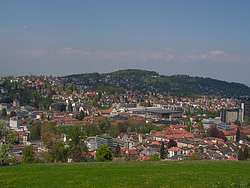
St. Gallen is surrounded by hills,
where there are many
places with a
scenic view over the city. Driving south
into the Appemzell area, Joerg took
me to one of them.
|
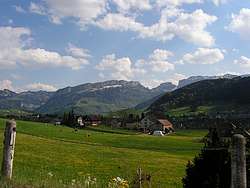
Appenzell is in the prealpine zone
of Switzerland. |
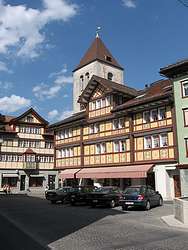
A little square in Appenzell. |
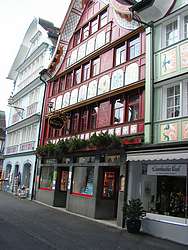
Richly decorated houses on the Main
Street.
Thos is a drugstore, Appenzell
style. |
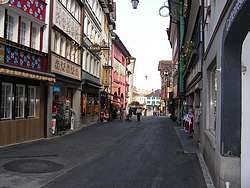
Main Street in Appenzell, now fairly
quiet but full of
tourists in summer.
|
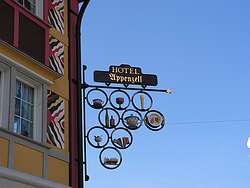
Also here: many cute signs, most of
them hand-forged.
This one diplays
the goodies available in this little hotel.
|
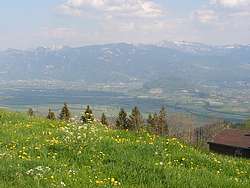
Approaching the Rhine Valley. The mountains
in the
background are in Austria.
|
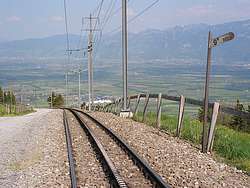
Yet another railroad line. Here it's
a cograil narrow gauge
track descending
very steeply from the Stoss Pass down
to the Rhine Valley.
|
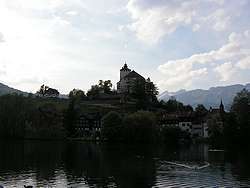
Werdenberg Castle near Buchs, where
the Rothenbergers
come from, documented
back to 1191 A.D. (no kidding!).
|
Fourth
week: Chapfensee, Buchs, Sargans Castle
On
April 28. the last of April’s unseasonably
warm weather began to fade as we drove up
above Mels. Mels is a town (yet still called
a village by Europeans) of about 6000 inhabitants.
Joerg wanted to show me Chapfensee, a natural
wildlife habitat Though the lake is
manmade for hydro-electric power, it is
an idyllic and totally scenic spot. Fishermen
of all ages dotted the northern shoreline
whiling away a still warm Saturday afternoon.
At times you could hear a fish jump, trying
to snatch the already prolific mosquitos
or whatever insects were unfortunate enough
to be in harms way for fish fodder.
Joerg
and his brother Richard spent many a summer
at this lake with their parents in the 'sixties,
and Joerg still knows its little coves and
isles like the back of his hand.
|
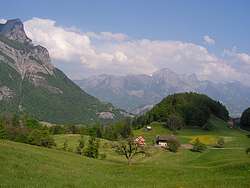
Mädris, a little hamlet
between the hills south of Mels.
|
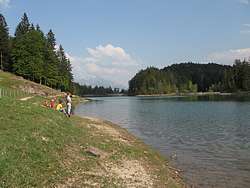
Chapfensee in Mels township, 3400 ft
above sea level.
|
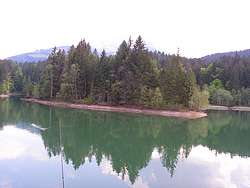
One of the little islands in the lake.
|
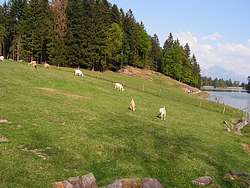
Goats next to the lake.
|
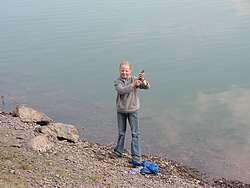
A girl proudly showing us a fish she
caught.
|
After
a leisurely stroll along the lake Joerg
headed us up a steep trail through dense
woods, heavily grounded with roots at all
angles on the forest floor. When I thought,
this is enough, let’s turn back, Joerg’s
contemplated place was soon reached: a bench
with a great view high high above Mels and
Sargans, but of course his teasing at my
fear of tumbling down the slopes was unceasing.
|
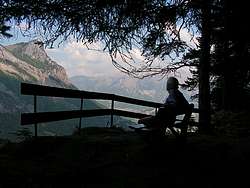
Joerg says such guard rails are
good enough for
Europeans, because
only Americans fall down the hills
to
keep their lawyers busy.
|
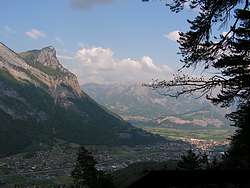
View over Sargans (right), Mels-Heiligkreuz
and Mt. Gonzen.
Gonzen is the only
place in Switzerland where iron ore is
found, not exploited any more, though, because
it's not
profitable. Apart from water
for hydro-electric power
plants, some
salt and that bit of iron, Switzerland has
no other natural resources.
|
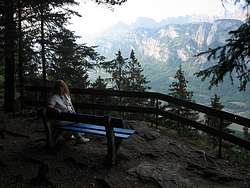
Oh yes, I was on that bench too, pretty
much to Joerg's
amazement. |
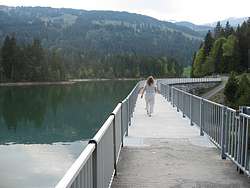
Me on the northern dam. Funny enough,
despite my fear
of heights I was not
even scared while walking on it.
|
The
next day we traveled to Buchs for a much
anticipated visit to see Aunt Dorothy, Joerg’s
father, Hansjoerg’s, sister. At age
ninety she still lives alone, is as active
as can be, walks every day and quit cross-country
skiing just a few years ago. With the sun
still hot, we sat outdoors under the protective
shade of a large yellow umbrella. The lovely
home, built by her grandparents, i.e. Joerg's
great-grandparents, about 100 years ago,
was like a step back in time to my
own Italian grandpparents' home. .
|
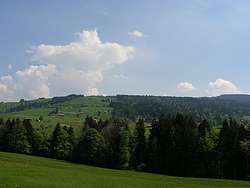
Joerg chose the much longer way through
the Toggenburg
Valley to show me another
lovely area. It's hilly in the lower
part and mountainous higher up.
|
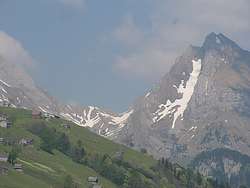
There are year-round mountain farms
up to an altitude of
more than 3500
feet. From this area, a pass road goes
down into the Rhine Valley.
|
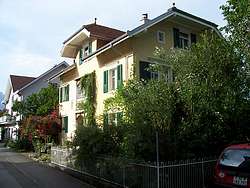
Aunt Dorothy's home in Buchs,
a town of about 10,000
inhabitants
in the Rhine valley, half-way between
Walenstadt and St. Gallen.
|
Next
door was a farrier. Even before he came
out, this former groomer of show horses
at the Bloomfield Hills Open Hunt Club,
could not tear away from thoughts of the
horses. Soon I was petting a lovely mare,
but the grey gelding, other than nodding
at my existence again and again, refused
to come to the fence until after the mare
had her water, and then only briefly.
The
farrier soon came out and kindly showed
off the mare’s talents. He had worked
in the USA and Canada as well as with the
Swiss National Circus, where he looked after
horses, zebras, giraffes, goats, buffaloes,
you name it. Training horses now is more
like a hobby, and an obviously well experienced
one at that.
|
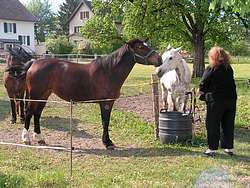
I could not resist talking to the horses
on the meadow
nearby.
|
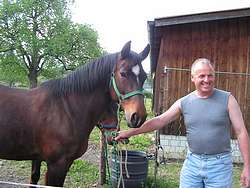
Ruedi Blumer, the farrier next door,
with Nikita, a former
circus horse.
|
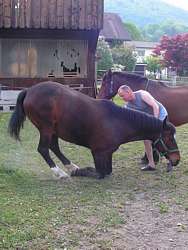
Special show just for us.
|
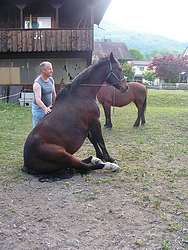
Proud horse and proud owner.
|
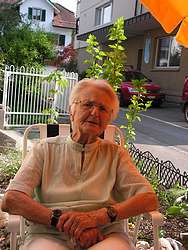
Aunt Dorothy, hard as nails and ever
so chipper.
|
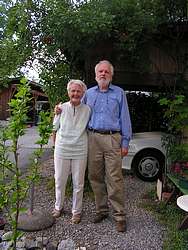
Aunt Dorothy and Joerg.
|
The
following day we met Mr. Marco Wyss, the
director of Heidiland ( www.heidiland.com ), in Sargans, yet
another medieval town only ten miles from
Walenstadt. Mr. Wyss, kindly gave us a few
minutes of his time to tell us a bit about
the business aspect of Heidiland, a huge
draw for the Swiss tourism industry, with
Japan, it seems, the leader in the pack,
especially in summer.
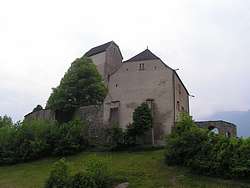
After
our interview with the director, we set
off to tour the Sargans Castle, which was
first mentioned in an official document
in 1282 A.D., nine years before the Swiss
Confederation was founded. However, there
already was a Roman watchtower in the same
place 15 B.C.. The tower looms right
over Heidiland offices and the narrow streets
of the medieval town center.
|
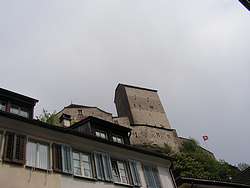
Sargans Castle seen from the Heidiland
Office.
|
The opposite side is not a steep but
still quite impressive.
|
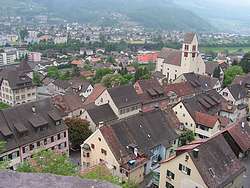
Looking back down onto the roofs of
Sargans.
|
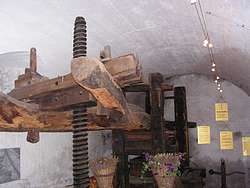
The huge tumbler boom of the 16th century
grape press.
|
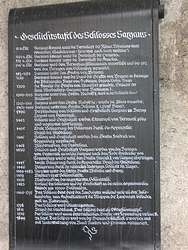
A sign displaying the history of the
castle,
starting with 15 B.C. and ending
with 1899 A.D..
|
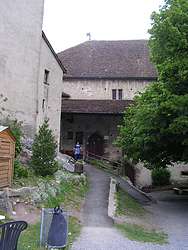
The central yard of the castle with
dining tables
of the restaurant below
a big linden tree.
|
Since
I never had been inside a true castle before,
and had only seen them in pictures and in
my imagination, anticipation had no time
to linger as we climbed the creaking steps
of the museum's six floors. Each affords,
via historical artifacts carefully and expertly
displayed, an opportunity to see what life
was like as you envision its romance, legends
and stories. A huge grape press from the
16th century with an almost 25 ft long tumbler
boom is on display in a cellar next to the
entrance.
The
museum was named European Museum of the
Year 1983. In 1987, it was included on the
list of the 37 museums most worth seeing
throughout the world.
|
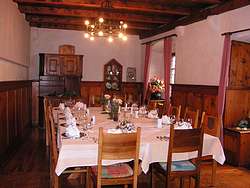
The Counts' Dining Room. |
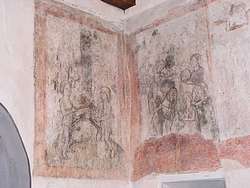
Mural paintings from the 14th century
inside the keep. |
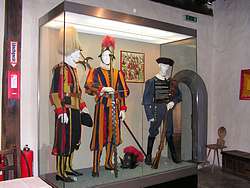
Old uniforms.
|
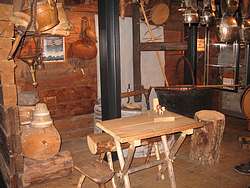
Alpine dairy cabin interior.
|
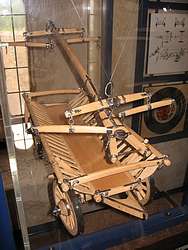
A traditional four-in-hand cart. Every
hardware part
is hand forged, yet the
whole exhibit is only a two
foot long
model.
|
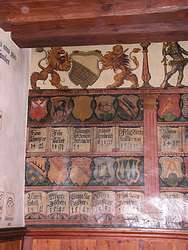
The murals on all walls of the big
Knights' Hall
show the names and coats
of arms of all the
sheriffs and castellans.
|
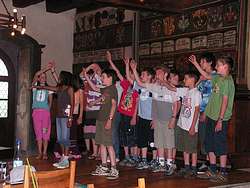
A special treat was being invited in
to watch local
schoolchildren rehearsing
for an upcoming play in the
Knights'
Hall. They were joyous in their demeanor,
blustering out melodies as if on Broadway
|
Fifth week: Calfeisental, Heidi
Village
One
day, Eleni, the mother of Maria, one of
Joerg's assistants, brought a cake, a special
treat from Glarus, where they live, not
much more than 10 miles from Walenstadt.
Maria and her family are Greek. Maria grew
up in Switzerland. Since her dad's retirement
a few years ago, her parents have been spending
more time in Greece again, and Eleni came
to say goodbye before traveling down south.
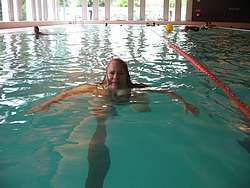
On
Saturday, Joerg and I went to Mels for a
swim. The pool was warm and inviting and
deep enough for diving, which I had not
done in quite a few years.
|
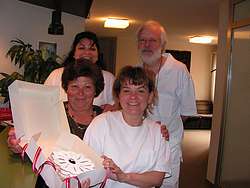
Maria and Joerg (rear row), Eleni and
Claudia plus, of course,
the cake.
|
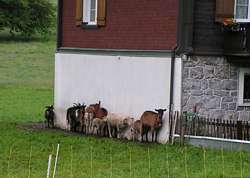
A rainy day. These animals are lined
up along the wall
in the modest shelter
of the roof.
|
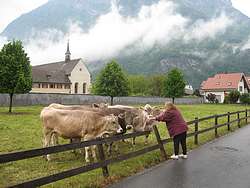
Young Swiss Brown cows and an American
tourist in front of
the old Capuchin
monastery in Mels.
|
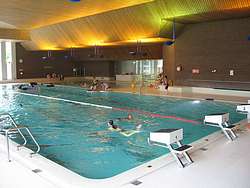
Mels has a nice indoor pool.
|
Swimming with a panoramic view of the
mountains -
very special. |
On
Sunday, Mai 6, Joerg took me up yet another
terror-may-strike-me-dead steep, windy road
above Bad Ragaz, the place that was one
of Europe's most important spas already
many centuries years ago.
While
still down below, we passed the majestic
Bad Ragaz Grand Hotel complex. After a few
steep hairpin bends we reached the Pfäfers
Monastery, a cultural center already in
the Middle Ages, now a psychiatric clinic,
a panoramic scenery with views over the
Rhine Valley and the surrounding mountains.
A gorge dominates much of the area.
High
above Vättis, we stopped for some photos
on the dam of one of the numerous manmade
lakes used for feeding hydroelectric plants.
Just below was a restaurant, a cozy
mountain café, quite popular with
the summer tourists but now, in early spring,
only a few were there.
The
weather was less than perfect, the exact
opposite of April. Low clouds partly hiding
the mountain peaks and patches of fog drifting
up and down the valleys gave the whole scenery
an eery touch - "Count
Dracula can't be far," Joerg joked.
|
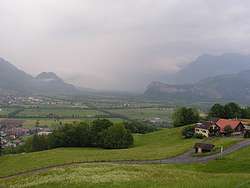
The valley basin of Sargans, seen from
the slopes of
the Pizol mountain range.
Not exactly inviting weather.
|
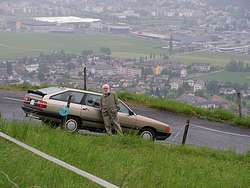
The roads are so steep, I feared
the car could just fall
down the hill.
|
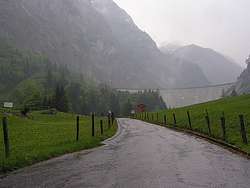
Approaching the Gigerwald dam from
below. I said I'd
screech if Joerg
took me up there.
|
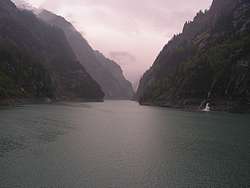
Looking up the valley from the dam,
about 4500 ft above
sea level.
|
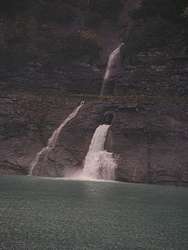
Little waterfalls feeding the
lake from all sides.
|
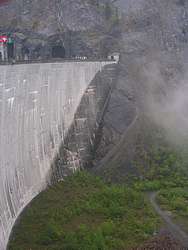
It's not one of the really big dams
but still
quite impressive.
|
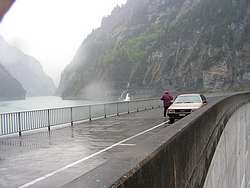
On the dam - and I even
left the car!
|
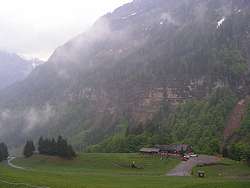
Driving down to the restaurant below
the dam.
|
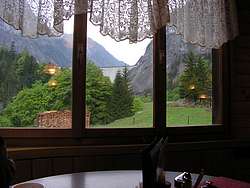
View from our table in the restaurant
back up to the dam.
|
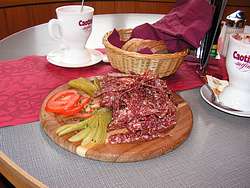
Our snack, which was rounded off by
a delicious ice cream.
|
Monday saw our first excursion
to the very core of the Heidi novel by Johanna Spyri (1827
- 1901), some 15 miles from Walenstadt.
Heidi was, along with
Black
Beauty
and the Bible, my most revered book as a
child. In fact, the book Heidi, behind the Bible, is the
2nd most widely published book worldwide!
That surprised me.
|
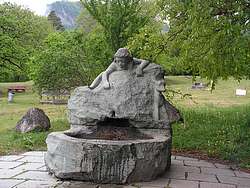
The Heidi Fountain on the way from
Maienfeld up to
Heidi's homeland.
|
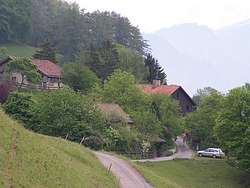
Approaching Oberrofels, Heidi's village.
|
As
we approached the original “birthplace”
of the fictional works of Heidi, a delightful herd of goats and
several chickens with a rooster carefully
guarding his Pride approached us in animal
greeting language. "Ahhhhbbabbabaahhh
Feed us!" they seemingly exclaimed.
So cute I could not resist caressing
one of them in my arms, where he actually
nuzzled me in return. However, the only
thing they could eat from me was a catalog
from the Heidi store, but their stealing
was stopped as Joerg quickly displaced it
from big Papa goat’s mouth.
|
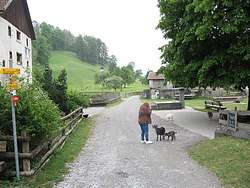
The welcoming committee.
|
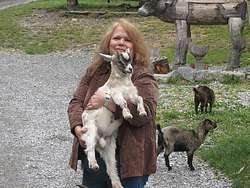
He seemed to like it.
|
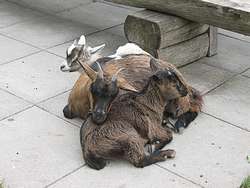
Goats just about everywhere...
|
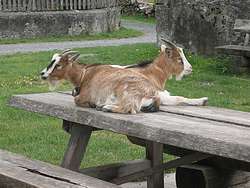
... even on the pic-nic tables.
|
The
little museum in what is assumed to have
been Heidi's house is quite precious, filled
with historical accuracies of life a real
Heidi would have had in her modest home.
Every detail is like it would have
been in a poor mountain farmer's home around
1880, when Heidi was written. Each
window gives light outside the dim interior
to the views all around of majestic mountains
that surround it and green valleys graced
with the bloom of spring wildflowers.
|
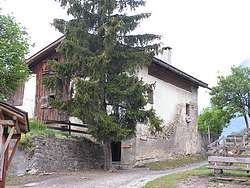
This very simple old house is where
Johanna Spyri, the
writer of Heidi, thought the little
girl could have lived.
|
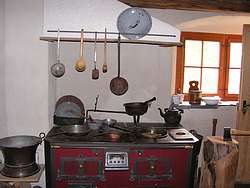
The kitchen stove, wood-heated, of
course.
|
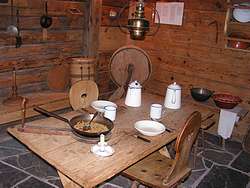
The kitchen table.
|
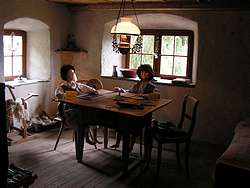
The little living room with Heidi and
Peter at the table.
|
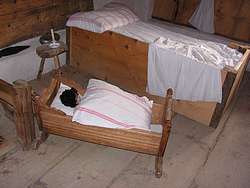
Heidi's very simple box-like bed and
a little cradle.
|
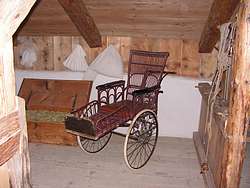
This could have been Klara's wheelchair,
the one Peter
pushed down the cliffs.
|
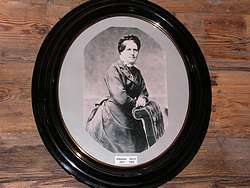
A photo of Johanna Spyri, the author
of Heidi.
|
A
walk up a steep trail from the Heidi house
to view the grandfather’s cabin, some three
ardourous for a Flatlander miles, was interrupted
by rain which had only been a sprinkle but
now threatened a downpour with no place
for shelter. The drive home through the
southern part of the Principality of Liechtenstein,
however, gave me a few new impressions of
that little country.
|
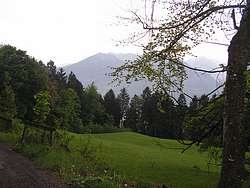
One of the mountain meadows on the
way up to the cabin
of Heidi's grandfather.
|
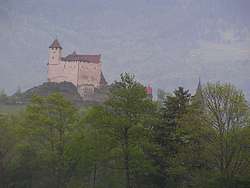
Another interesting view of Gutenberg
Castle in
Liechtenstein.
|
6th week: Ticino & Italy, Roggwil, Central
Switzerland
Joerg
surprised me again with a treat of driving
through the Swiss Alps southward ho! Up
to the area of the southernmost sources
of the Rhine, then through the San Bernanrdino
tunnel under the main ridge of the Alps
and down on steep motorways into the so
called sunroom of Switzerland. Besides
the mountain roads, never have I been through
so many tunnels in all my life. More than
23 miles under ground, and this in only
one day yet!
I
so wanted to see Ticino, the Italian speaking
part of Switzerland, not because I'm 50
% Italian but because of the palm trees.
Many years ago, when Joerg told me there
are palm trees in Switzerland in latitudes
that correspond to Michigan's Upper Peninsula,
I could barely believe such. Now he wanted
to show me it was true.
A
stop in the very ritzy lakeside town of
Ascona was beautiful. Residences on
Main Street sell for upwards of 25 million! Most
of the streets are brick lined, as is the
case in many towns in Switzerland. The lake,
Lago Maggiore (i.e. "the bigger lake")
is about 36 miles long, two miles wide
and goes from southern Switzerland into
northern Italy, taking many bends around
the mountains and hills, so you never see
more than just a fraction of the whole lake.
|
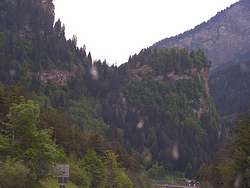
An "on the fly" shot through
the windshield: entering the
southern
part of the upper Rhine Valley, a very important
way across the Alps in the Middle Ages.
|
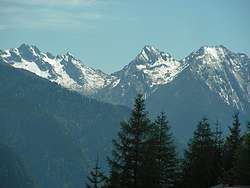
The descent from the San Bernardino
Pass into the
Mesolcina Valley again
and again opens new and
fascinating
views.
|
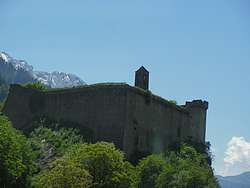
Because of the importance of this route
across the Alps,
there are medieval
castles galore.
|
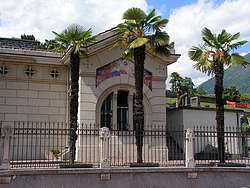
Yup, palm trees! The entrance of an
old cemetery on Main
Street in Ascona.
|
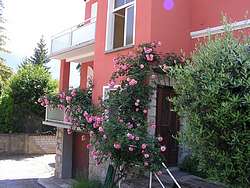
Just like in other parts of Switzerland,
there are flowers
everywhere.
|
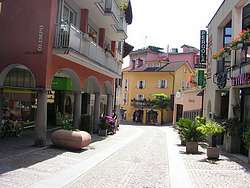
Downtown Ascona: Switzerland with quite
a lot of Italianity
or Italy with a
Swiss touch - that is the question.
|
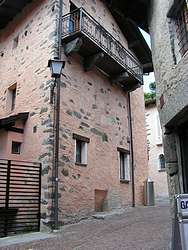
Steep and narrow streets in Ascona.
|
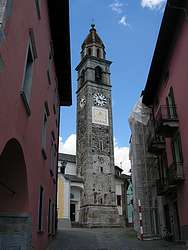
The old churches, too, look very Italian.
|
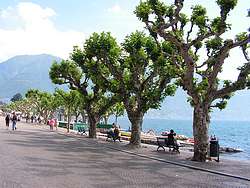
Ascona's waterfront promenade,
one of Switzerland's
most expensive
quarter-miles, as Joerg put it.
|
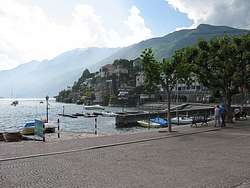
The Lago Maggiore is the lowest place
in Switzerland,
about the same altitude
as Lake Michigan.
|
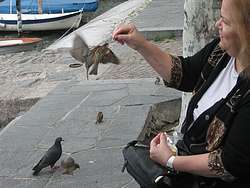
The sparrows on the waterfront were
so bold, they ate
bread crumbs right
from my hands, hovering like
hummingbirds.
|
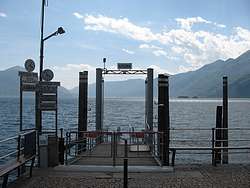
Passenger ships on Lago Maggiore have
a dense time
table and are a part of
the public transportation network
just
like trains, post busses, city busses etc..
|
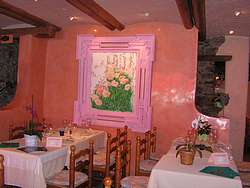
Inside one of the restaurants on Ascona's
waterfront.
|
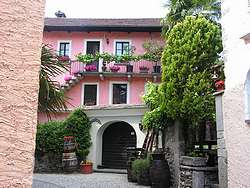
Italian architecture, mediterranean
vegetation, Swiss tidiness.
|
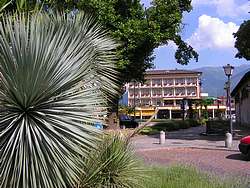
Modern architecture looks more Italian
than Swiss too.
Again lots of mediterranean
plants.
|
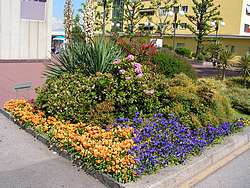
Flowers everywhere, in private yards
as well as on public
ground.
|
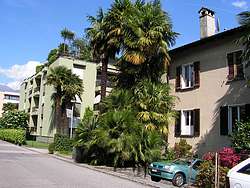
And, of course, palm trees everywhere,
even on roofs!
|
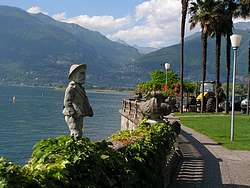
A little lake shore park on the way
to Italy.
|
A short drive later we were at
the Italian border and crossed into Italy,
the country half my ancestry is from, with
nary a nod of impatience by the customs
officers. Passport in hand was not
needed but there just in case….
|
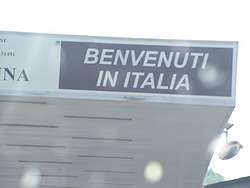
A welcoming sign on the
customs office in Dirinella on the
Lago Maggiore shore road, shot through the
windscreen.
|
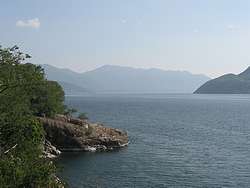
One section of the Italian part of
Lago Maggiore. There
were people swimming,
and that in mid May.
|
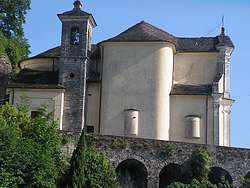
An old church on the way to Luino on
Lago Maggiore.
|
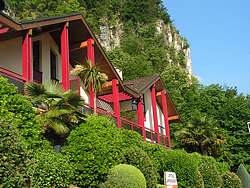
Beautiful vacation homes between Luino.
Italy, and
Ponte Tresa, Switzerland.
|
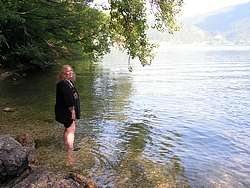
Back in Switzerland,
Lago di Lugano was so inviting that
I decided I must, if not swim, at least
walk in the
refreshingly cold water.
|
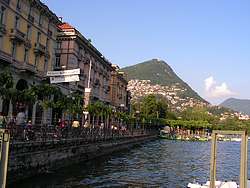
Lugano, a bustling city on a beautiful lake,
has hotels and
business buildings all
along the waterfront. In the
background:
Monte Bré, one of Lugano's vantage
points.
|
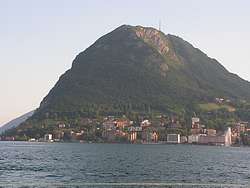
The city is surrounded by steep mountains
with great
views, most of them accessible
by funiculars. This is
San Salvatore.
|
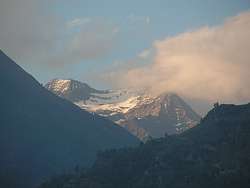
Mountains over the Blenio Valley on
the Lucomagno Pass
route back to Walenstadt.
|
After almost twelve hours on the
road we arrived back in Walenstadt around
eleven p.m., I was so tired I immediately
crashed, happily to have finally made it
to Italy and eager to write back home to
tell those nearest and dearest to me of
that very fact!
Sunday
the wind was picking up as we drove northward
to the Lake Constance area. First Joerg
took me to Werdenberg, the tiny town near
Buchs, were his ancestors came from. The
town proper covers less than two acres yet
is a classic medieval town. It was carefully
restored in the 'sixties and 'seventies..
|
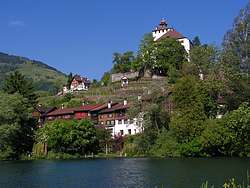
Werdenberg Town and Castle on the Werdenberg
Lake.
|
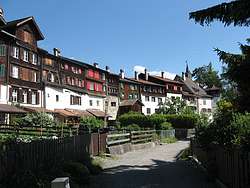
The waterfront.
|
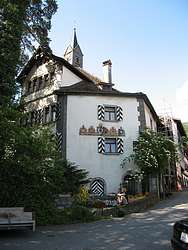
The entrance
to the 300 ft long Main Street.
|
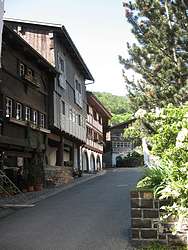
Main Street leading up to the town
square.
|
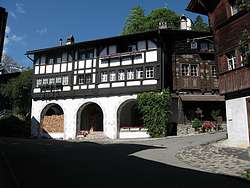
The tiny
town square.
|
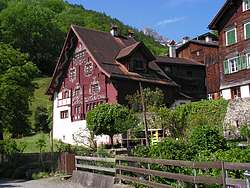
The Snake House, so named after the
snake-like ornaments.
|
After
the way too brief photo stop in Werdenberg
we again hit the road and drove to Roggwil.
It was a special day as finally I would
meet the two not so new anymore kids of
Richard's daughter Helene and her husband
Marcos. Richard, the ever proud Grandpa,
and Brigitte, just as so in her role as
Grandma, met us at the car with Leia in
tow. The girl immediately jumped down to
see her Uncle Joerg, proclaiming his name
over and over again. Precious!
Between
lots of talking, a little resting in comfortable
lawn chairs in the back yard, some badminton
and a barbecue the day flew by.
|
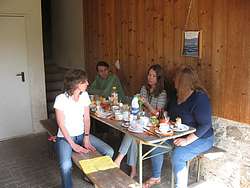
Outdoor brunch at Richard's: Brigitte,
Marcos, Helene and me.
|
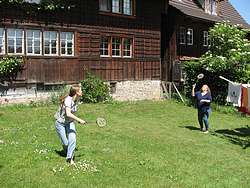
Playing
badminton with Helene.
|
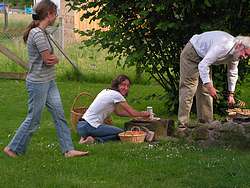
Preparing
dinner in the back yard.
|
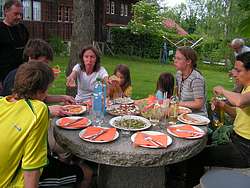
Counterclockwise: Benny, Toby, Richard,
Brigitte, Leia,
Yana, Helene, Joerg,
Marcos.
|
Monday
morning Joerg had yet another surprise. I
had expected a quite stay at home day, but
we were back in the car and headed to Central
Switzerland. The area is just beautiful.
Gentle deep green hills give way to steep
mountains, and with rain headed in were
bedecked in a descending fog.
Our
first stop was in Zug, a nice old town but
also an important financial hub with headquarters
of many globally active companies.
|
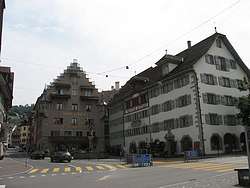
A beautiful square with old buildings
in downtown Zug.
|
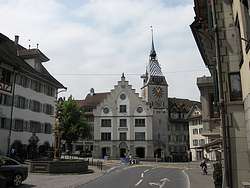
Looking
in the opposite direction.
|
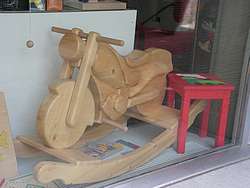
A wooden
rocking bike in a store window. I don't
like
motorbikes, but this one I liked.
|
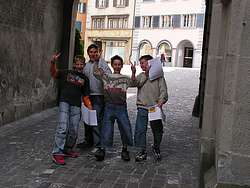
These school kids from another town
were on an
orienteering course and
asked us for directions.
|
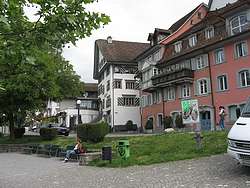
Old buildings on the waterfront.
|
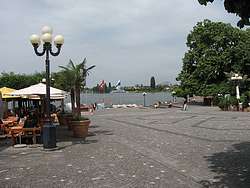
Harbor
square and fish market on Lake Zug.
|
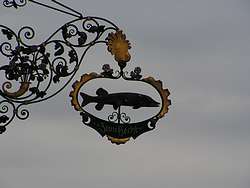
Also here you can find many beautiful
old signs,
especially on restaurants.
|
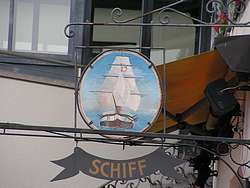
Another old restaurant sign in downtown
Zug.
|
I
fell in love with the lakeside city of Lucerne. We
parked next to tennis courts on the eastern
end of the downtown area. The walk into
the downtown district was canopied with
well kept trees and flanked by very lovely
and old hotels on one side, boats and a
few floating restaurant / cafés on
the other. Some pre-WW-I paddle wheel steamers
still are doing their regular service on
the lake, though - the biggest
inland lake steamer fleet in the world.
|
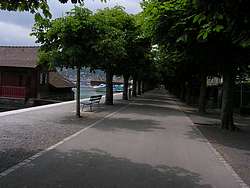
Lucerne's waterfront promenade.
|
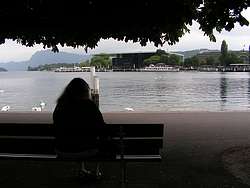
Resting
on a park bench with a view of the world-famous
concert hall.
|
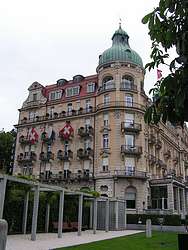
The Palace, one of the time-honored
hotels on
the lakefront.
|
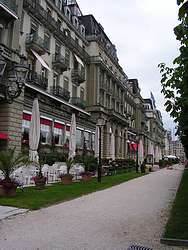
The National, another Fin-de-Siècle
hotel next
to the lake.
|
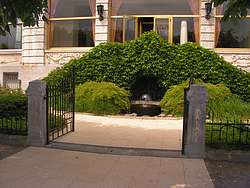
The entrance to one of the hotel gardens.
|
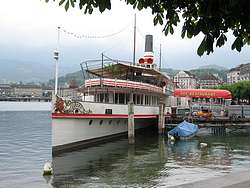
An old paddle wheel steamer, maybe
100 years old, now
being used as a
restaurant.
|
The
walkway over the Reuss River, called Kapellbrücke,
was built in 1333. A fire from a boat destroyed
major parts of it in 1993, but it was carefully
reconstructed. There were many tourists
but the atmosphere was peacefully serene
and friendly. It is a town I want
to go back to and discover its every corner,
and for me, a true country girl in most
respects, it is the only big town I can
truthfully say that!
|
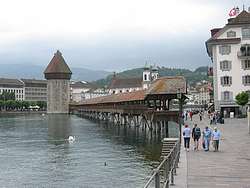
The Kapellbrücke with the
Water Tower and the Jesuits'
Church.
The 670 ft long bridge is the oldest wooden
bridge
in Europe. The 140 ft tall Water
Tower was used as a prison,
watchtower
and treasury.
|
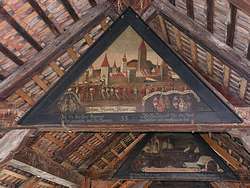
Two of the 17th century paintings inside
the bridge that
survived the fire of
1993. |
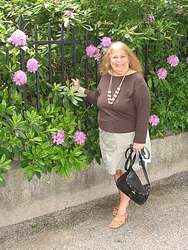
Flowers everywhere.
|
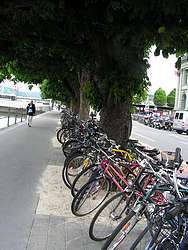
A bicycle parking lot next to the RR
station.
It often makes sense to use
a bike instead
of the car. You can
get everywhere, you can
easily bypass
traffic jams, and gas is way too
expensive
to be wasted on buying croissants.
By the way, gas prices in Europe have increased
only by 10 % since 2000. Go figure.
|
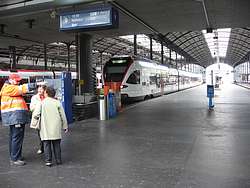
As in any Swiss town and city,
the very dense railroad
network goes
right into the center. Lucerne Central
Station has departures to various directions
every few
minutes. Most cities and
major towns can be reached at
30 or
60 minute intervals.
|
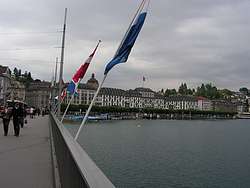
On our walk back to the car: Seebrücke
(Lake Bridge) and
some of the big hotels.
|
Another
favorite of mine was the village of Gersau
on Lake Lucerne. A restaurant we drove
past marked its claim as the Big City Restaurant. That made Joerg
crack up. In Switzerland any settlement
with less than 10,000 inhabitants is called
a village, unless it has a history as a
fortified town in the Middle Ages, with
ramparts, town gates and the like. Settlements
between 10,000 and 100,000 inhabitants are
called towns. Anything bigger may be called
a city but rarely is.
So,
Gersau is a village, not a city. Period.
However, a lot of new building going on
acclaims that it indeed is growing and my
heart said to it, please, be careful, don't
lose what you already have mastered. A number
of very old, very beautiful hotels line
along parts of the shoreline. Well kept
homes, many manors in my book of reason,
made life look very well lived for the fortunate
well-heeled.
|
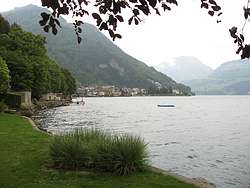
Gersau on Lake Lucerne. Not even the
crummy weather
could affect its charm.
|
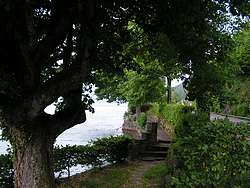
A lovely little park between the winding
road and the steep
shore near Gersau.
|
Although
the weather was not inviting at all, Joerg
took me to Brunnen, a little town (well,
actually a village) on a sharp bend of Lake
Lucerne. The other side of the lake can
be accessed only by boat or ship. One of
the clearings on the very steep wooded slopes
of that other shore is where the Swiss Confederation
was founded in 1291. And, believe it or
not, it's still just a meadow, and you still
need either a ticket for one of the steamers
or very good hiking shoes to reach it. No
parking lots, no tour busses, no monuments,
just simple rural peace and quiet.
Unfortunately,
the Federal Archives in Schwyz
were closed. That's were the original charter
of the Swiss Confederation, signed on August
1, 1291, and other important deeds of similar
vintage, are displayed. Joerg related parts
of Switzerland's history to me. The simple
mountain farmers of the area decided to
chase the Austrian sheriffs out of the confines
of their little communities of Uri, Schwyz
and Unterwalden on Lake Lucerne, all of
them simple democracies already then. In
the course of several centuries, Austria,
then a rapidly growing empire, again and
again tried to subdue the disobedient freedom
fighters, to no avail. Asymmetric warfare
enabled those only lightly armed hordes
of patriots to defeat armies of knights
in full armor. Taking advantage of the very
rough terrain, the Swiss light infantry,
dressed in mere farmers' work clothes, often
drove big armies of heavy cavalry into lakes
or over cliffs. After more than a dozen
of lost battles, the Austrians eventually
gave up, and the eternal and total independence
of the Swiss Confederation was granted.
|
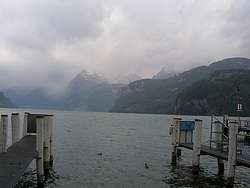
Not exactly picture postcard weather.
This is the landing
stage in Brunnen
on Lake Lucerne. One of the little
clearings on the other side of the lake
is where the Swiss
Confederation was
founded more than 700 years ago.
|
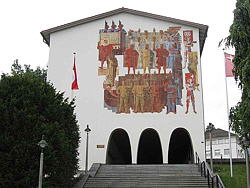
The Federal Archives in Schwyz.
The founding documents
displayed here
are almost 500 years older than the
Constitution of the USA, yet there's no
pompous
palace, just a simple building
with a mural painting
from the 'thirties.
|
After
another day full of interesting sights we
came back to Walenstadt in the evening.
7th
week: Engadine again - my favorite anyway
Wednesday
we were packed and all to ready to hit the
road for the two plus hour trip back to
Tarasp. As I wrote above of my first thoughts
that ran through my mind of Tarasp, Valatscha
in particular of course, is a return home.
The Rothenberger home was purchased from
Joerg’s primary school teacher, Fritz, who
still maintains a spot behind the home.
The
way back “home” as I prefer to call Valatscha,
Joerg decided to take the longer way -
for my benefit of course - and
avoided the tunnel and instead drove
us over the Flüela Pass. By
now I should be used to mountain roads,
but must say, that trip through that pass
was harder on me than any road or flight
in my life….hair pin turn after hair pin
turn and when will it end I thought trying
so hard not to express my terror, fear of
heights mode in full gear. Did not
work too well, and when we finally stopped
and I got out I felt as if I had been in
a saddle a long long time, and that not
on a Tennessee Walker’s smooth gait but
that of a bucking bronco!
Fears
aside, the pass was truly beautiful and
should have made up for my fears of heights,
so very real for me. Halfway up the pass,
the rain turned into snow, but the roads
stayed pretty good, but the mini spring
blizzard prevented all but a few photos.
As
we approached Tarasp, my anticipation was
near climax and even more expressed than
the first jet lagged arrival. I eagerly
snapped photos at just about anything, so
glad was I to be back.
|
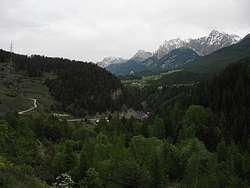
Tarasp Castle (above the center of
the picture, just a
dot) seen from
the steep and winding road between the
Flüela Pass and Scuol.
|
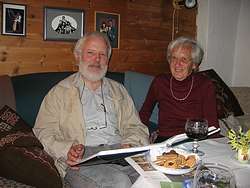
First thing after arrival was visiting
Marietta next door.
We talked about
the Great Lakes (she lived in the USA
in the 'fifties), hence the atlas...
|
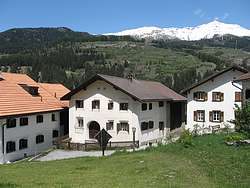
The house of the Rothenberger family
in Valatscha.
|
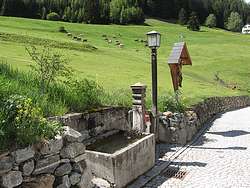
The fountain just across the street
has the best water
I've ever tasted!
Although it's the same water as in the
house, it's more fun here.
|
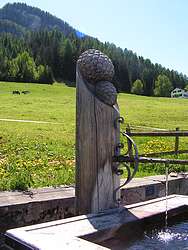
The bigger fountain down the street.
|
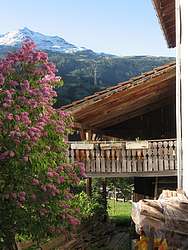
Marietta's side porch.
|
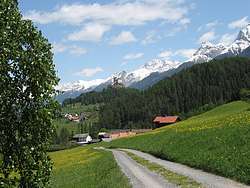
The castle seen from the little road
from Valatscha
to Aschera.
|
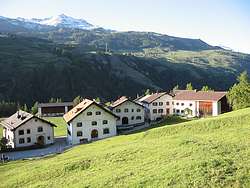
Valatscha in the early evening sun.
The Rothenbergers'
house is right in
the middle.
|
Thursday,
just like Wednesday evening, was cool, rainy
and a bit dreary. We stayed in to
enjoy the coziness of the fire. Friday
the sun was back, and we drove to Scuol,
both to sight-see and to shop for company,
as Richard and Brigitte would be spending
the night. Scuol may be a small town,
but has many streets to walk, and even get
slightly disoriented on which way to go
back to the main street.
|
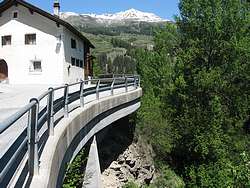
This photo shows how steep the terrain
in Valatscha is: The
road at the entrance
is supported by pillars.
|
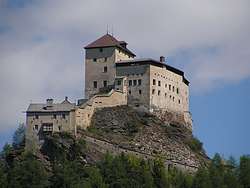
On the way to Scuol: Tarasp Castle
seen from the west. |
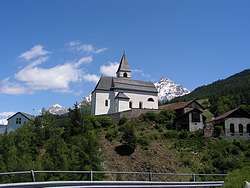
The Catholic church in Fontana, the
largest of the ten
"fracziuns"
of Tarasp.
|
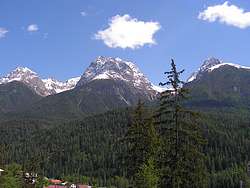
The Lischana range south of Scuol.
From left to right:
Piz Ajüz,
Piz Lischana, Piz Madlain.
|
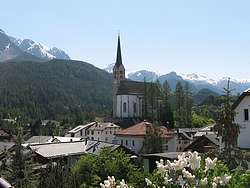
The old center of Scuol, with the church
on a steep
hill high above the Inn
river.
|
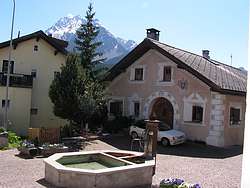
Scuol: little squares, old fountains
and beautiful old
houses with al-fresco
sgraffitto ornaments everywhere.
|
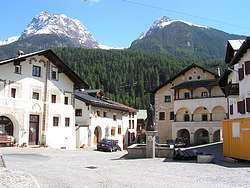
One of the picturesque squares
in Scuol.
|
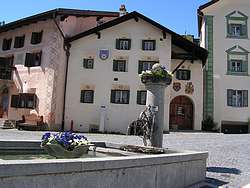
Another beautiful square in Scuol.
Those fountains run
real mineral water,
stuff that would be bottled and sold
elsewhere.
|
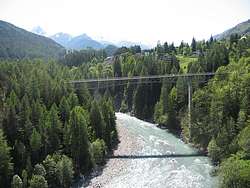
The Inn river seen from the church
hill.
|
Don't
ask me why no one shot any photos while
Brigitte and Richard were visiting us. They
arrived Friday afternoon. We had a great
time together, me cooking an American dinner
and a pretty international brunch. Saturday
afternoon, after their departure, Joerg
and I hiked from Fonatana, the biggest of
Tarasp's ten settlements ("fracziuns") up the hills
to the natural preserve area of Lai Nair
(Black Lake).
The
uphill walk called for many stops to admire
the many wildflowers, some in large gatherings,
others just singular or in a small bunch.
We followed hoof prints, pretty fresh too,
as often we had to side-step the animals'
droppings. The vistas along the way were,
of course, breathtaking, and no camera can
do them justice. At the lake, we decided
to take a steeper way down to Fontana. Soon
Tarasp Castle came in sight again, from
yet another angle, a view I shall never
tire of. Before we went back to Valatscha,
we paid a visit to the little church of
Fontana on a steep hill on the edge of the
Zuort Gorge.
|
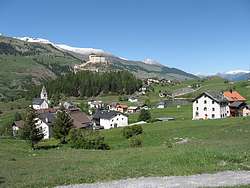
Fontana
and the castle from south.
|
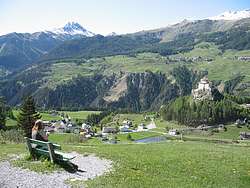
Resting on a bench with a nice view
over the castle and
several "fracziuns" of Tarasp.
|
Gaining more and more height.
|
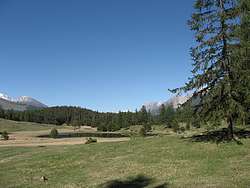
The Lai Nair plateau.
|
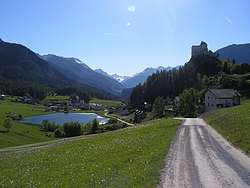
On the way back to Fontana.
|
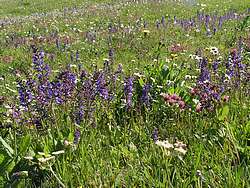
At an elevation of 4400 ft, spring
with 'zillions of wild
flowers was
in full swing.
|
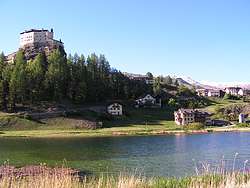
The omnipresent castle and the very
clear little lake, where,
despite its
shallowness, pikes of up to 5 ft have been
caught.
|
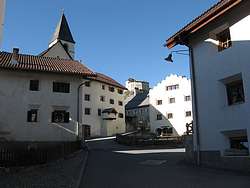
The center square in Lower Fontana.
|
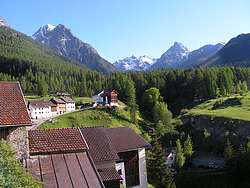
View from the graveyard at the
church in Fontana down
into the Zuort
Gorge and further southward into the
Plavna Valley.
|
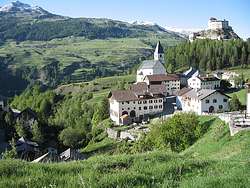
The necessity of saving precious
agricultural land often
made Swiss mountain
farmers build their settlements
in the
steepest places.
|
To
call the almost 400 year Rothenberger home
charming, well words may fit to some extent,
but it goes far beyond that. It commands
an elegance, an understated nobility, unassuming
in its role as a farm house only in part,
most of her dealt with the keeping of animals
and their feed.
The
air in the Engadine is so clean, there was
practically no dust inside the house as
we arrived in early April, amazing after
five months without any cleaning, dusting,
vacuuming etc.. In the whole big house I
found only two little cobwebs. What a joy
to sleep in this clean home and be awakened
by cow bells day by day.
|
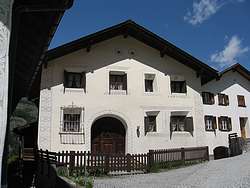
All Engadine farm houses are gathered
in villages or
hamlets, and they all
have a barn at the side that is
away
from the street. On the front side, they
have a
gate-like door that allows the
hay wagon to be pulled
through the
dwelling to the hay lofts in the barn.
|
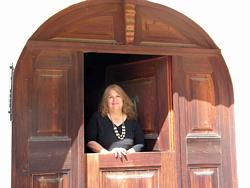
Of course this front door isn't used
to let pass a
whole hay wagon any more,
yet it still boasts the
interesting
multi-winged design that was a necessity
for many centuries.
|
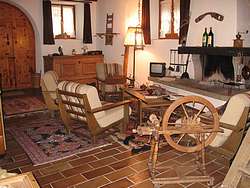
What now is the living room, formerly
served as a place to
store carts, plows,
heavy tools etc. and to do all sorts of
maintenance work.
|
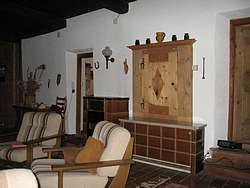
Looking in the opposite direction.
The kitchen door is on
the left, the
dining room door on the right hand side.
The ornamental closet between the two
doors is the
fuse box (no kidding!).
|
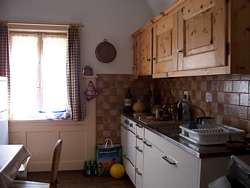
The vaulted kitchen has traditional
furniture where
appropriate and modern
one where necessary.
|
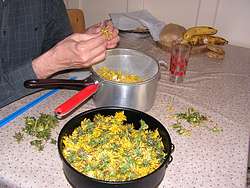
Preparing dandelion blossoms for making
old-fashioned
honey-like dandelion
spread.
|
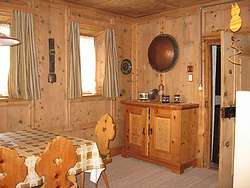
The dining room furniture was
made in 1973 to match the
old paneling
and coffered ceiling.
|
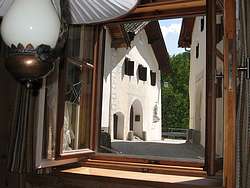
Looking out of one of the dining room
windows.
|
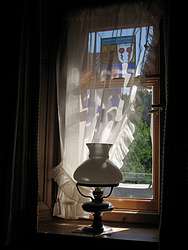
Another window in the dining room.
|
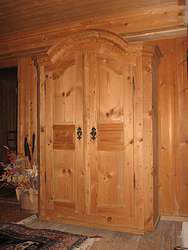
Old furniture matches the old structures
of
the building.
|
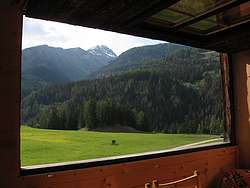
A very special place is the second
dining room, which
was built into the
barn by Joerg's parents. A part of the
wooden wall can be folded up to the ceiling
to provide a
generous view of the valley
and the mountains.
|
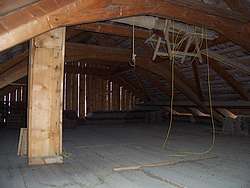
The third floor of the haylofts in
the barn, directly
accessible from
the house through several doors.
|
A
special treat in Valatscha is getting to
know Marrietta. She is truly one of
the most kind and remarkable persons I have
ever met. At eighty-four she lives alone
and in full competence, gardens with a flourish,
walks every day. Her gate is truly like
that of one fifty years less her age. I
asked her, how does she manage? She
never even realized I meant all alone in
the Alps, how does she do it, because, face
it, nothing there is close by. She
replied with total no miss a beat, “I have
the telephone, the radio and the tv. If
I need anything, it is all right here!”
And her eyes shine with pure health in the
reply, a true joie de vivre. An inspiration,
an up front role model for all who
meet her.
Then
there are Helen and Arthur Netzer with their
adult sons, Marcus and Andri. Besides Marietta,
they are the only other year-round inhabitants
of Valatscha and the only ones that still
run a real farm.
The
other houses are, like the one of Richard
and Joerg, just vacation homes, filled with
life only a few weeks a year. But there
is a community of the owners and regular
visitors that organizes meetings, parties
and the like, as for instance a potluck
dinner party on every August 1st, Switzerland's
national holiday. When the weather is bad,
that party takes place in the Rothenbergers'
barn.
|
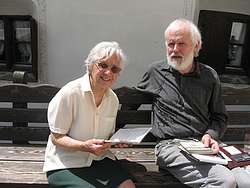
Marietta and Joerg talking about traditional
cooking in the
front yard. She lent
us a book with regional recipes she
acquired in the forties.
|
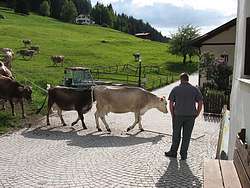
Marcus Netzer and his well-trained
cows: They cross the
street in Indian
file on rubber mats in order to prevent
damage to the cobblestone pavement.
|
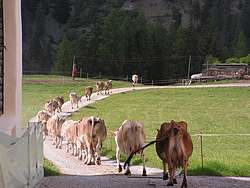
Soldiers couldn't do it much better...
|
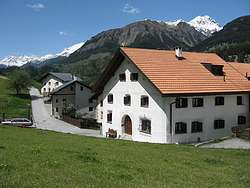
A few more of the houses in Valatscha,
all of them
former farm houses now
used as vacation homes.
|
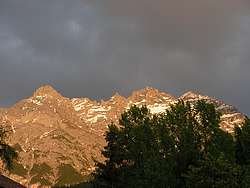
Alpenglow on the Pisoc range, i.e.
the evening sun making
the mountains
look reddish.
|
After
a few great days in Tarasp we drove back
to Walenstadt on Monday, May 21. Joerg chose
the somewhat longer way over the Arlberg
Pass in Austria, which allowed me to add
another country to my "been to"
list.
|
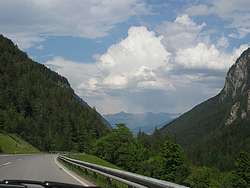
Driving down the lower Engadine
towards the Austrian
border.
|
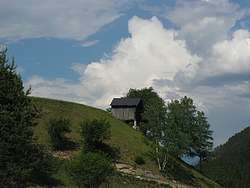
A little hay shack on one of those
steep hills. I can't
imagine how they
even mow those slopes.
|
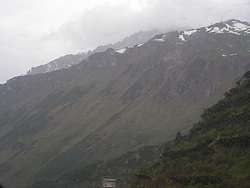
After a few miles on Austrian territory,
the weather turned
bad again, as if
it was trying to frighten me again while
crossing the Alps. |

Due to the bad weather I shot no interesting
photos on the
rest of our way home.
These signposts were in Feldkirch,
Austria, very close to the Swiss border.
|
Eighth week: Railroad Club and Zurich City
On
Thursday, Joerg took me to the weekly meeting
of the regional Railroad Amateurs' Club.
He is one of those buffs who are building
a big model layout in one of the big bomb
shelters of the secondary school building
in Walenstadt. For many years the club members
had kept sending me greetings through Joerg's
e-mail, especially Hansruedi Gloor, the
club's jokester, as Joerg put it. Of course
I had often sent greetings back the same
way. Now it was time for me to meet them
in person.
The
guys took me in stride, no big deal though
I had worried about being a lady and invading
the sacred territory of a men's club. Do
they accept women members? From my
experience, I bet so as long as she is a
true blue RR aficionado like they all are.
As for me, other than model trains, my only
RR experience is riding the Clinch Park
train at the former Traverse City Zoo, and
occasionally being allowed to switch the
tracks and control the engine of cousin
Garry’s (still elaborate some 50 years later)
train set.
|
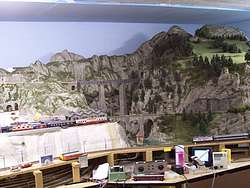
The scenery is based on the characteristics
of the area,
with high mountains, deep
gorges, bold bridges and lots
of tunnels.
|
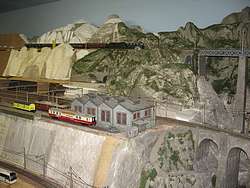
The landscaping shows all stages from
wooden framework
to mesh wire and styrofoam
used for rough shaping to
plaster sculpting
to painting to planting grass, trees etc..
|
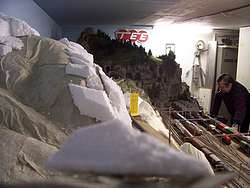
Looking down from the mountains. The
guy on the right
is Hansruedi Gloor,
my "special friend."
|
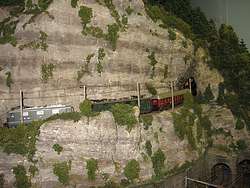
There are many helical tunnels in Switzerland,
and there
are two on this layout too.
|
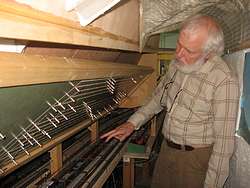
Joerg showing me the switchboard of
one of the large
underground fiddle
yards.
|
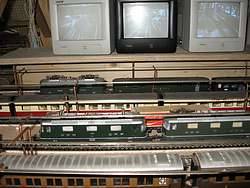
The fiddle yard system down below is
so large, it needs
video surveillance
to check the most important tracks. |
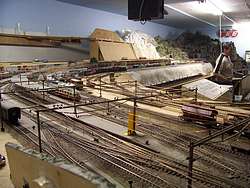
Wide areas still are to be finished,
which will take years,
but that's part
of the fun as long as the traffic addicts
can run their trains through the construction
grounds.
|
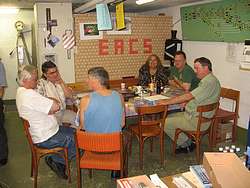
The table where the guys have their
drinks and cookies,
discuss plans and
exchange jokes. The patchwork wall
behind my back consists of thousands of
old train tickets.
|
Saturday
afternoon we went to Zurich to spend the
weekend with Joerg’s cousin Doro. She is
the eldest of the four daughters of Aunt
Dorothy and just about the most gracious
hostess I have ever met. She thrives
on entertaining - does it with a passion
- the fortunate guests who are invited over.
Doro makes one as comfortable (and
full) as can be. An avid reader, her
wide interests and life long work caring
for others as a professor at a school for
social siences makes her a pure treat to
be around.
|
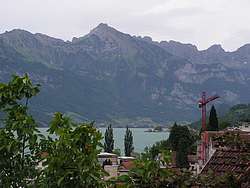
Looking back over the lake on the way
to Zurich:
Walenstadt is right in the
middle of the opposite shore.
|
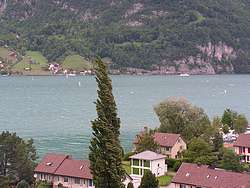
It was a windy day, and there were
many wind surfers on
the lake. The
little village on the other side, Quinten,
can
be reached only by boat or on foot.
No roads, no cars.
|
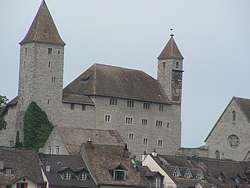
We crossed Lake Zurich on a bridge
on a shoal where
there was an almost
one mile long bridge already in the
Middle Ages. The northern end was guarded
by the castle
of Rapperswil.
|
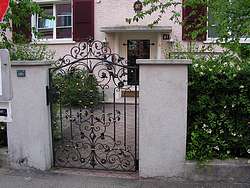
Doro lives in a neighborhood fairly
close to downtown
Zurich City yet amazingly
quiet. All front and back yards
are
beautiful and well looked after.
|
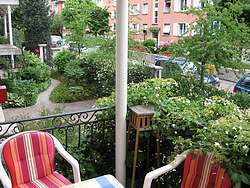
Doro's apartment is on a raised ground
floor, with a
balcony on the front
side (photo above) and another
one
on the equally nice back yard.
|
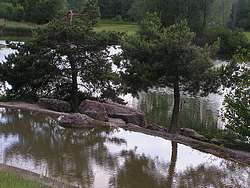
The recreational area of the new campus
of the University
of Zurich is barely
five walking minutes away.
|
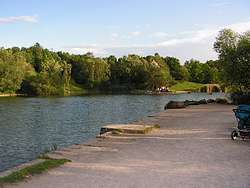
Groups of students and other folks
were enjoying the
beautiful evening
on the park pond.
|
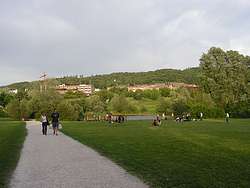
The new campus was built in the
early eighties as the
old one, very
close to the city center and the Federal
Polytechnical School, was bursting
at the seams.
|
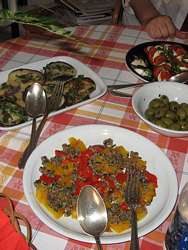
Doro treated us to a great Italian
dinner with
various antipasti (photo),
saltimbocca and
a yummy fruit dessert.
|
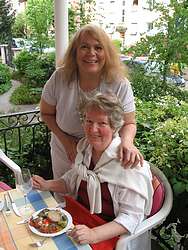
Doro, 61 years old this week, has been
physically handicapped all her life
but is
as active as can be.
|
Sunday
morning, Doro surprised us with a brunch
with the typical Swiss Bircher Müesli,
various kinds of bread and six sorts of
cheese. Then she drove us to the Zürichberg,
one of Zurich's local mountains. The three
of us strolled the walkway, with Lake Zurich
as the backdrop. It was most enjoyable. We
decided to take a peek at Hotel Zürichberg.
There, drinks are available together with
another dose of panoramic view of the city
and the lake.
A
man seated in front of us casually perusing
the Sunday paper, coffee at hand, reminded
me of the fact that it has been two months
since I shared in that delightful pastime
of enjoying a quiet Sunday reading the Record-Eagle
as is often my habit. And that brought
me to realizing it has been as long for
viewing the tv news too, that I do not miss!
|
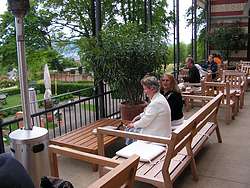
Doro and I admiring the view from the
terrace of the
Zürichberg Hotel.
|
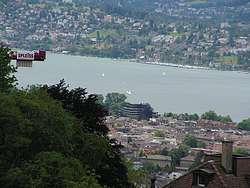
Lake Zurich goes right into the heart
of Zurich City.
|
After
a nice hot chocolate on the terrace, Doro
dropped us off in downtown Zurich, right
between the medieval center and the Kunsthaus museum. In Switzerland,
as in most parts of Europe, city planners
try to keep things together as closely as
possible, which is great for pedestrians.
Most towns and cities were there already
for many centuries before the advent of
motorcars. In pre-combustion-engine times
it was not possible to cover miles for going
to the barber's or for buying a loaf of
bread.
The
same principle is still applied these days.
In Zurich the Kunsthaus, the University including
University Hospital and Dental Institute,
the Polytechnical School, several other
schools, the Federal Library, the National
Museum, all municipal and cantonal authorities,
the financial district (of global importance),
dozens of museums, hundreds of restaurants
and hotel, thousands of stores and offices
as well as the headquarters of hundreds
of globally active companies can be found
in an area of less than three square miles.
So
it was a walk of only a few steps from the
ramparts of the medieval center to the Kunsthaus ("House of
Arts"), one of the most important art
museums in the world with probably the biggest
collection of classic modern art. What I
wanted to see most was the collection of
paintings by Claude Monet, particularly
his water lily paintings, but I was amazed
at the number of world-famous paintings
by other artists I found there too.
|
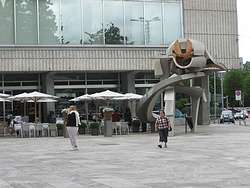
Restaurants and cafeterias everywhere,
indoors and
outdoors. The Kunsthaus runs two of them.
|
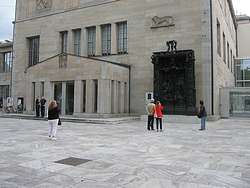
The main entrance to the museum,
built 1910. The big
black thing is
Auguste Rodin's Gates of Hell.
|
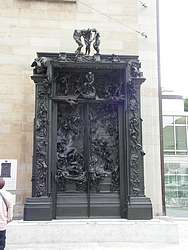
Rodin worked about 37 years
on this bronze
sculpture.
|
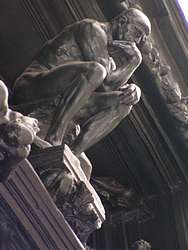
The Thinker, a motif Rodin used
in various
forms and materials.
|
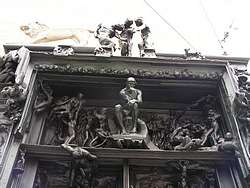
Calling the sculpture utterly
complex is still an
understatement.
|
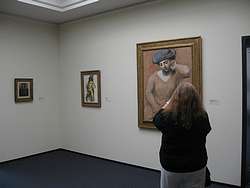
There is an amazing number of paintings
by Picasso I
would not have expected
to see here.
|
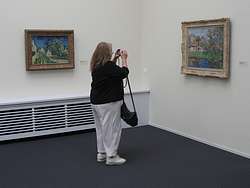
Here I was: After some paintings by
Van Gogh I finally
saw my first real
Monet: Chaumière
normande.
|
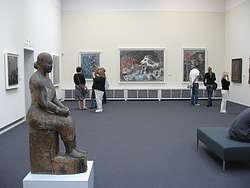
However, it took me quite a few Matisses,
Chagalls,
more Picassos and a Marini
to get to Monet's water lilies.
|
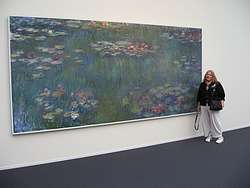
A dream come true: me next to the latest
of Monet's big
water lily paintings,
finished 1926.
|
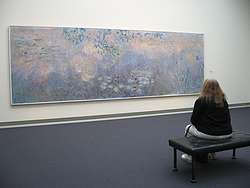
Le
bassin aux nymphéas avec iris, finished 1922.
|
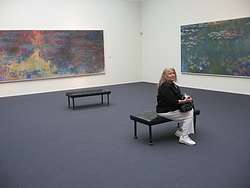
Behind me is the third of the water
lily paintings. I'm sort
of overwhelmed.
|
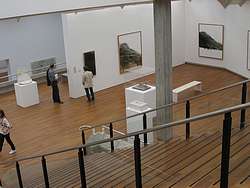
The section with works of Cy
Twombly.
|
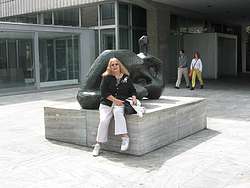
Walking
around in a museum can be tiring.
|
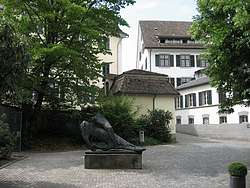
There is a seamless transition
from the 20th century
museum complex
to the surrounding buildings, which
are many centuries older.
|
Joerg
then took me for a walk into the old center
of the city, which was a town already 2000
years ago.
|
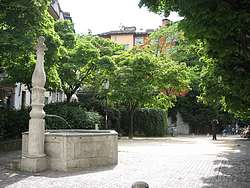
Although the medieval buildings are
close to each
other and the streets
are very, very narrow, there
always
is a bit of space for a little park or the
like.
|
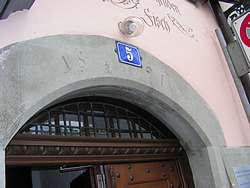
If you look at the year on the stone
lintel, 1591, you
may think, "Wow,
that's old!" Forget it. This house
was
built in the 11th century and restored
in 1591.
|
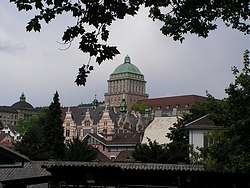
Just e few steps from the medieval
core area: the
Federal Polytechnical
School (dome on the left) and
the University
of Zurich (green dome in the middle).
|
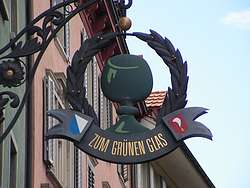
Traditional hand-forged signs on restaurants
and stores
also here, as in so many
Swiss towns.
|
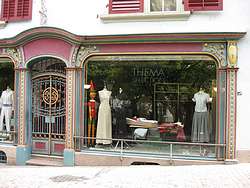
There are very fancy little stores
everywhere.
|
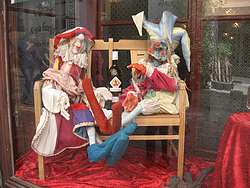
These two funny dolls are part of a
wine store window.
|
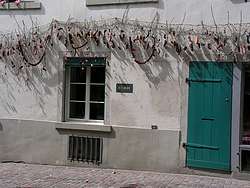
Some house are decorated in very interesting
ways, some
related to the buisiness
inside, so just for the fun of it.
|
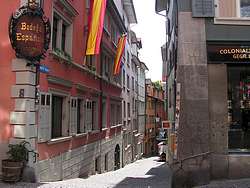
As I wrote above, the streets are very
narrow. No one
thought of four lanes
1000 and more years ago.
|
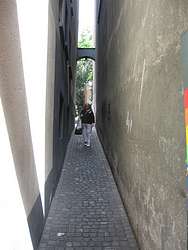
When Joerg asked me to walk down this
more than
just narrow street, I first
refused to do such. He
told me that
no one would kill or rob me, and he
was right.
|
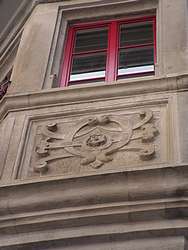
Most of the very old houses have all
sorts
of ornaments in stone, wood or
paint.
|
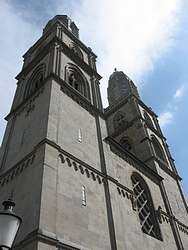
The steeples of the Grossmünster are a bit of
a surprise in the middle of the maze of
narrow
and winding streets.
|
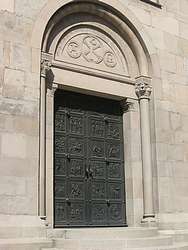
The south portal of the Grossmünster
church in pure
Romanesque style.
|
Joerg
told me that the oldest still existing parts
of the Grossmünster (= Great Minster)
were built in the 9th century and the major
parts of the nave between 1100 and 1220.
After 300 years as a Catholic church, it
became the cradle of the Swiss reformation.
|
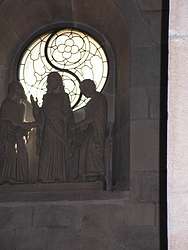
Stone statues and ornamental window over
the inner lintel of the south portal.
|
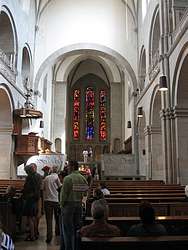
The church is not particularly big
but imposing
with her unpresuming dignity
of some
800 years.
|
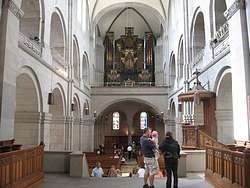
View from the choir stalls to the organ
gallery.
|
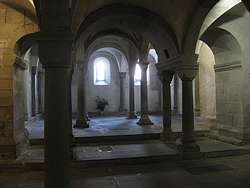
The crypt below the chancel, built
about 1200 years ago.
|
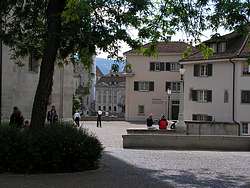
The square in front of the Grossmünster is very simple.
Stairs lead down to the Limmat River.
|
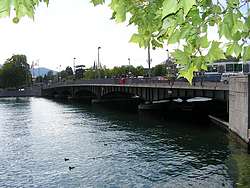
The Quay Bridge is where the Limmat
River leaves Lake
Zurich.
|
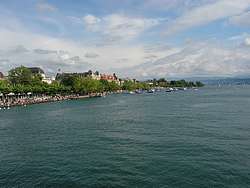
The generous Uto Quay esplanade seen
from the Quay
Bridge. When the weather
is better, there is a great view
of
the northeastern Alps from here.
|
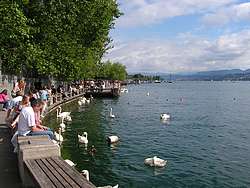
Most of the lake shore is accessible
to the public, with
parks, esplanades,
museums, outdoor exhibitions etc..
|
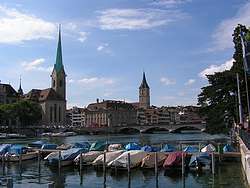
The Limmat River with the Fraumünster church (left, part
of a convent founded 853 A.D.) and
St. Peter's church
(right, dating back
to the 7th century).
|
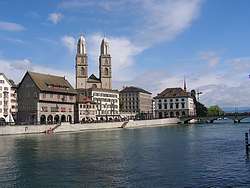
The Grossmünster and the historical
waterfront seen from
the west bank
of the Limmat River. By the way, all the
water from our lake in Walenstadt goes
down this river.
|
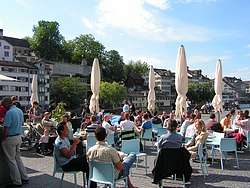
Outdoor cafes everywhere, also right
on the riverside.
The hill in the background
was the site of the Roman
citadel of
Turicum about 2000 years
ago.
|
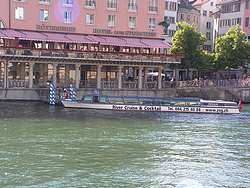
Believe it or not, some hotels on the
Limmat River have
their own landing
stages for boats.
|
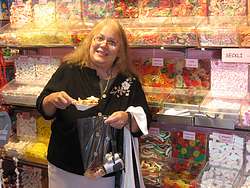
I found a cute little candy store
under the arcades of the
Grossmünster
- my idea of paradise?
|
I
was worried about the way back to Doro's
without a car, but Joerg kept telling me
that would be no problem at all. Public
transportation is available everywhere.
There is no place in the whole city where
you have to walk more than 300 yards to
a streetcar or bus stop, and at most of
the stops the average time to wait for a
ride is around two minutes. If you have
to find a parking space for your car at
your destination, you usually save time
by using public transportation.
So
we walked two minutes to the nearest stop,
waited two and a half minutes, boarded a
streetcar, got off at a streetcar hub after
three minutes, waited three minutes, boarded
another streetcar, got off after two minutes
and walked four minutes to Doro's apartment.
If you could follow me, that equaled 16.5
minutes. If we had gone by car and using
public parking lots, we could have spent
twice as much time.
Anyway,
although we had planned on driving back
home for dinner, Doro asked us to stay a
bit longer. The improvised meal was well
worth the stay. After two days full of interesting
impressions we arrived in Walenstadt on
Sunday evening.
|
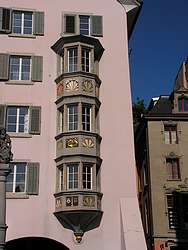
Many of the old buildings have very
interesting
oriels, not as richly decorated
as those in
St. Gallen but beautiful.
|
The lion is the heraldic animal of
Zurich City,
while the blue-white coat
of arms stands for
the Canton Zurich.
Seen on the City Hall next
to the streetcar
stop.
|
Inside one of the streetcars.
|
One of the numerous streetcar hub stations.
|
Joerg spotted this one: In Zurich,
Internet addresses can
be found on
signposts.
|
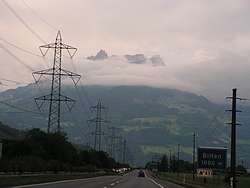
On the A3 expressway back to Walenstadt:
the peaks
of the Mürtschen range
peeking out of the clouds.
|
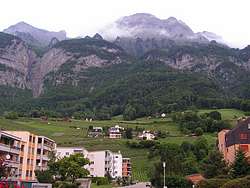
Back home: looking north and, of course,
upwards from
the parking lot at Joerg's
practice.
|
Ninth
week: Bad Ragaz, Maienfeld and Lindau
On
Friday, June 1st, Brigitte and Richard came
to Walenstadt for dinner. I surprised them
with a Mexican menu plus a dessert based
on a recipe I got from Doro, with some Michiganian
modifications. Then it was time for us to
say goodbye for a while. Thank you very
much for your hospitality. I'll be back
as soon as possible.
|
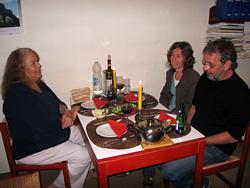
At the dining table with Brigitte
and Richard.
|
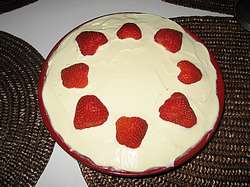
Fruit dessert according to Cousin Doro's
recipe.
|
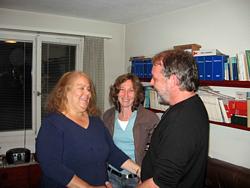
Saying goodbye to Richard and Brigitte.
|
On Saturday, the weather wasn't very inviting
for sightseeing, but we went to Bad Ragaz
all the same. That little town has been
one of Europe's most important spas since
the Middle Ages. Monks of the Pfäfers
Abbey, founded 740 A.D., discovered the
healing properties of the 99° F water
from a spring deep in the Tamina Gorge around
1240. The first spa was built in 1350. The
first chief of medical staff in 1535 was
Parcelsus, the famous physician, philosopher
and natural scientist.
For
photos of the gorge and the spa of 1718
see www.sengers.ch/stgallen/taminaschlucht/taminaschlucht.asp . The word "Bad" in the place
name has nothing to do with the Englisch
word "bad." It is what "bath"
is in English and, as part of a place name,
simply means a spa.
By
the way, the water of that spring was also
meant to heal Klara's disease in Johanna
Spyri's Heidi novel, but it was
joy of life, pure air and an effort of will
that eventually healed her.
|
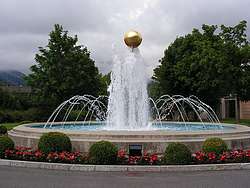
Fountain in front of the casino in
Bad Ragaz.
|
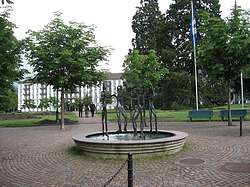
The Grand Hotel complex is the only
5-star hotel in
Switzerland that is
not located in a big city.
|
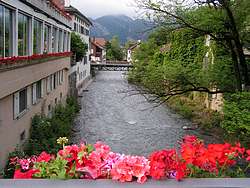
The Tamina River runs right through
back yards of
many hotels in downtown
Bad Ragaz.
|
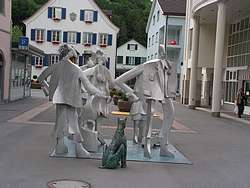
A funny piece of modern art in downtown
Bad Ragaz.
The dog is made of metal
too.
|
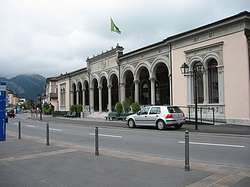
The old
spa in Bad Ragaz, built 1867 and still in
use
after a thorough restoration finished
just a week before
we visited the town.
|
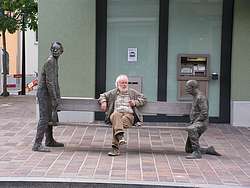
Another interesting work of modern
art.
|
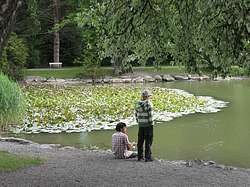
Kids fishing in the Giessenpark, a
recreational area as
large as the entire
town.
|
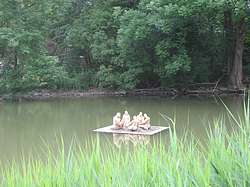
Yet another whimsical work of art:
five curvy nude
ladies on a float.
|
Serenity
at its best.
|
Old trees were not just cut up for
lumber or firewood
but converted into
little playgrounds instead.
|
Maienfeld, the little town around which
the Heidi novel is centered,
is just a few miles from Bad Ragaz on the
other side of the Rhine.
The
weather still wasn't quite postcard-like
as we arrived, so the photos may look a
bit somber.
|
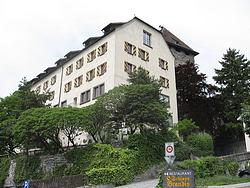
Brandis Castle dominates downtown Maienfeld.
|
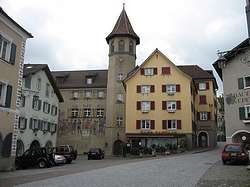
The old Town Hall.
|
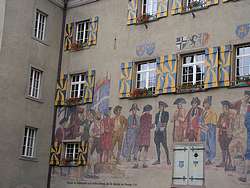
Historical fresco on the Town Hall.
|
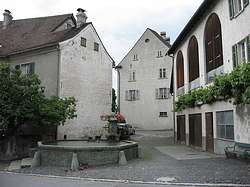
There are little squares with old fountains
everywhere.
|
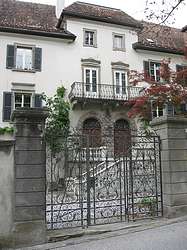
Centuries
of low-key patrician wealth lend
the
little town much of its character.
|
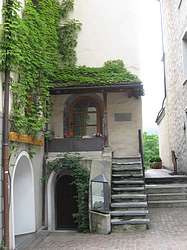
This is not a castle but a bakery.
|
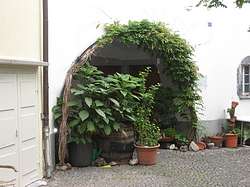
Picturesque details can be found all
over the place.
|
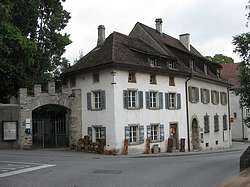
Houses on Main Street, still in regular
use after many
centuries.
|
Joerg also took me to Fläsch, a little
village only two miles from Maienfeld. Fläsch
has only 600 inhabitants but 23 vineries.
Practically every square foot that is not
too steep for walking is used for growing
grapes.
|
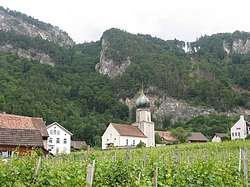
Even the little church is surrounded
by vineyards.
|
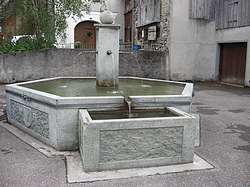
Also here, every little square has
its fountain.
|
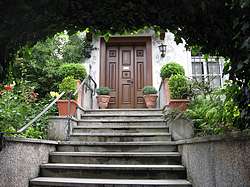
This is the entrance to an old restaurant.
|
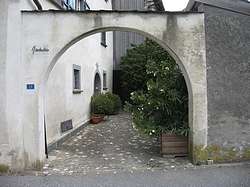
Even the doorway of a simple back yard
has its very
own charm.
|
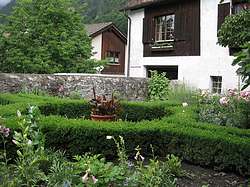
The little gardens show the love of
their owners.
|
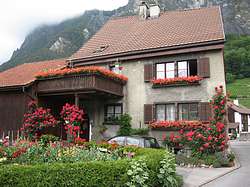
This old farmhouse may need a lick
of paint, but the
garden looks very
well looked after.
|
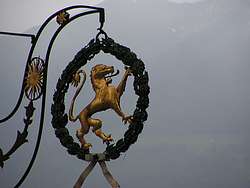
Very beautiful old signs also here.
|
Sunday brought the sunshine back, time to
show some more photos of Walenstadt.
|
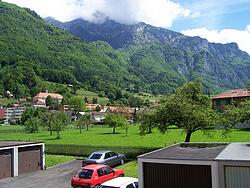
View from the living room at Joerg's
practice, looking
northeast.
|
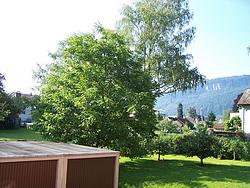
Looking southeast from the little office.
|
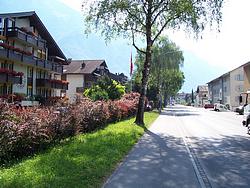
Seestrasse (Lake Street). The practice
is right behind
the flag pole in the
middle of the picture.
|
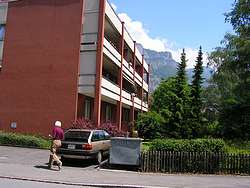
The front yard of the practice building.
|
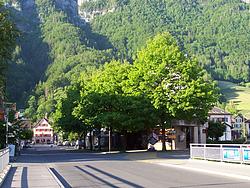
This is the Main Street. The town hall
and the post office
are hidden behind
the trees.
|
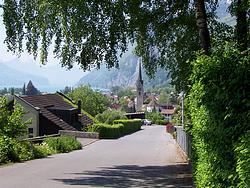
The very old Catholic church and the
lake seen from
one of the streets at
the foot of the mountains.
|
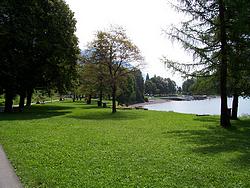
One of the parks on the lake shore
next to the harbor.
|
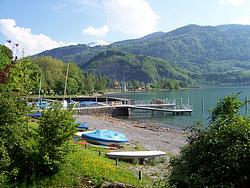
The tour ship landing docks of the
little harbor.
|
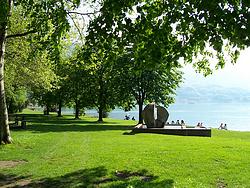
The park on the southern side
of the harbor.
|
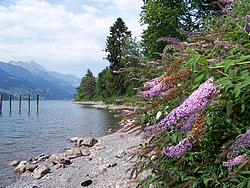
Lake shore west of the harbor. The
lake is ten miles long
and only
one mile wide but up to 120 fathoms deep.
|
In view of the fine weather, Joerg had yet
another surprise up his sleeve. In the afternoon
we drove all the way down the Rhine Valley
to Lake Constance and through a few miles
of Austrian territory into Germany. Like
on our dash into Italy, we barely scratched
the surface, but it was worth it. We visited
Lindau, a quaint town that was settled already
in Roman times, about 2000 years ago. The
medieval town center is on a little island
just a few hundred feet from the mainland,
accessible across two bridges.
|
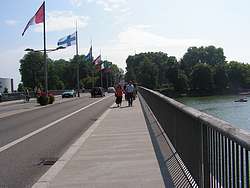
One of the bridges that lead into the
medieval town
center.
|
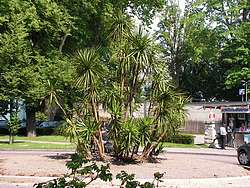
Believe it or not, there are palm trees
also here, in a
latitude that corresponds
to northern Lake Superior!
|
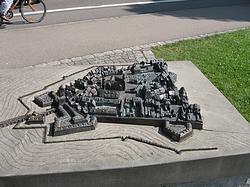
A bronze model of the medieval town,
with only one
bridge. The second bridge
was built much later.
|
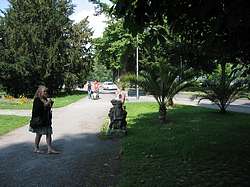
American tourist shooting palm trees.
|
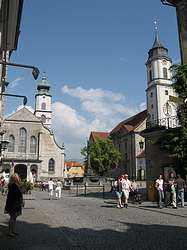
One of the beautiful squares in downtown
Lindau.
|
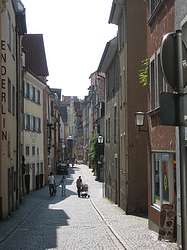
The streets are as narrow as in Swiss
towns.
|
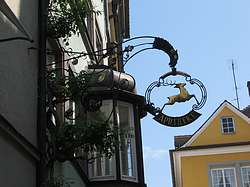
Ornate restaurant and store signs
also here.
|
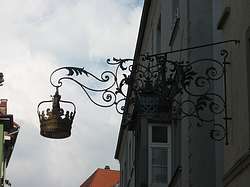
Yet another traditional restaurant
sign.
|
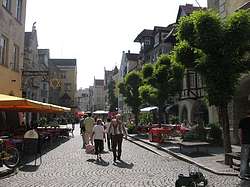
Most of downtown Lindau is one
big pedestrian mall.
|
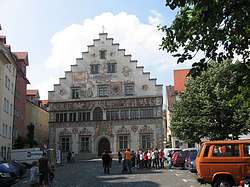
The Town Hall close to the harbor.
|
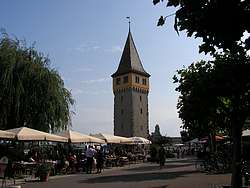
Approaching the harbor with a watchtower
built in the
11th century.
|
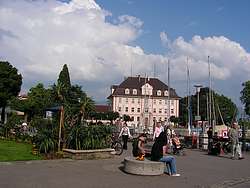
The old customs buidling at the harbor.
|
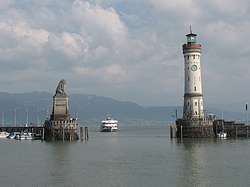
Germany's southernmost lighthouse,
built 1856 - 1857.
|
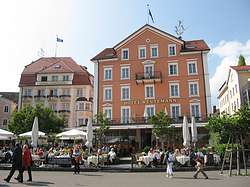
There are several nice hotels and restaurants
on the
waterfront. We chose this one
for a break.
|
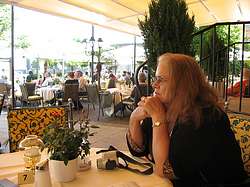
Enjoying the rest at the waterfront
cafe.
|
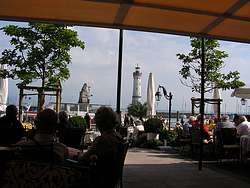
Nice view from the cafe over the harbor.
|
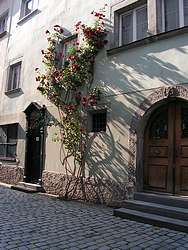
There's room for life everywhere.
|
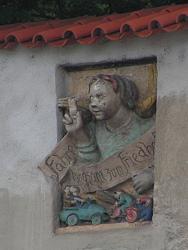
Looks ancient, but the car, the motorbike
and
the text on the blurb give its
real age away:
"Don't speed on
your way to the cemetery."
|
On the way back to Walenstadt, Joerg drove
through the extremely hilly Appenzell region
once more, with beautiful views of Lake
Constance and cute villages very close to
each other.
|
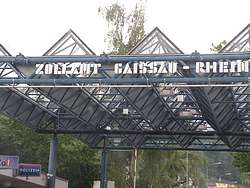
Back into Switzerland: the customs
post in Gaissau-
Rheineck. Crossing
the borders is very easy, which
is
important in an area where you can hit four
countries
within less than an hour
(no kidding).
|
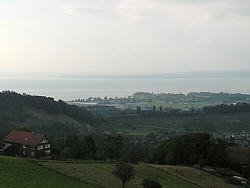
Eastern Lake Constance with the St.
Gallen Airport
area seen from the hills
of Appenzell.
|
On the last evening before my dreaded flight
back across the Atlantic, Joerg took
me out for dinner at the Churfirsten Hotel
in Walenstadt.
|
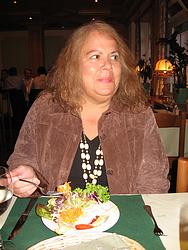
We had
a nice dinner in the very beautiful
dining room - all knotty pine
paneling and
ditto coffered ceiling.
It reminded me of the
Engadine.
|
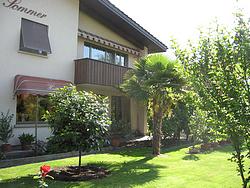
There are palm trees also in Walenstadt!
This is one in
the front yard of Joerg's
barber.
|
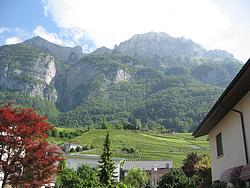
A last glimpse of the gorgeous mountains
north of
Walenstadt before leaving
for Zurich Airport.
|
The flight back to Chicago was very smooth
and quiet, and the landing was as gentle
as can be. I think I'm beginning to love
flying...
|
Even
some more coming soon! |
|