Chapter 10: Driving
A fast car isn't all it takes to win races, you need good driving skills too.
11.1. The basics
There are two ways to be fast: you can either travel a smaller distance, or do it at higher speed. Or you can combine both. This means that the path your car travels should be short as well as without any sharp turns. Let's look at an example:

This drawing shows the ideal line through a simple, 180 degree corner. The ideal line is drawn in red, and the track edges in black. This type of driving line is called Out In Out: approaching the corner, you take the outside, as far as possible, you take the inside line in the middle of the corner, and you take the outside again on the exit. The middle part of the corner, drawn in blue, is called the apex of the turn, or the clipping point. The wider you can make the radius of the line, the faster you can take the corner. Or in other words, the less speed you'll lose.
Note that all the braking should be done in the straight line, before the circular part begins. The acceleration too begins after the circular part, when the car is tracking straight. During the circular part, the car's velocity is constant. It has to be, assuming that the radius of the path is constant and the tires are delivering maximum grip.
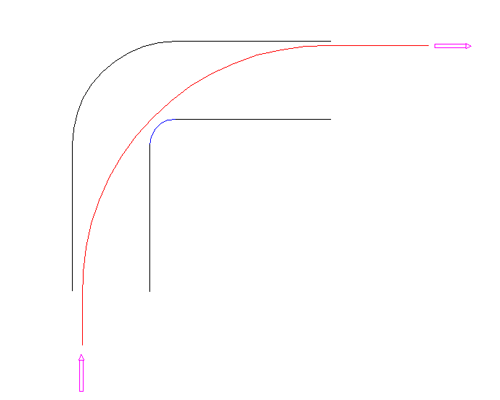
The same goes for any type of corner: the line with the largest radius is the fastest one. A 90° turn is pictured: brake, turn in, keep the radius of the turn constant, so don't accelerate or brake, and then straighten up and accelerate. You begin and end the corner on the very outside, and almost clip the apex in the middle part.
The most important thing isn't to know where the ideal line is and try to stay on it, it's being able to stay on it the whole time, without any wild moments, going sideways or braking too soon or too late,... Consistency is the key: never lose the momentum. You lose more time if you mess up once than you can gain rounding 10 other corners perfectly.
11.2. Advanced technique
In the previous examples we only considered one single corner, preceded and followed by a short straight. But this isn't always the case, like in chicanes, or turns preceding a long straight. If there is another sharp turn or a long straight following the corner, the Out In Out line might not be the fastest line. For example: exiting one corner very wide might mess up the entrance to the next one because you're still on the wrong side of the road. in that case, the Slow In Fast Out type of cornering is probably faster.
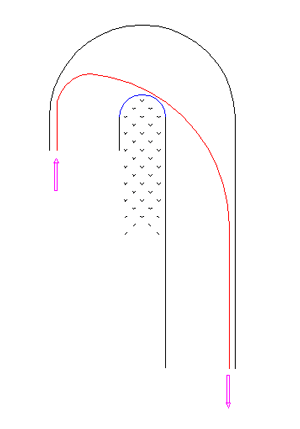
The Slow In Fast Out type of cornering is based on the fact that usually, a car can brake harder than it can accelerate. As shown in the drawing, you brake a little later and harder, and turn in more sharply. But from that point on you can take the corner at a higher speed than you would using the Out In Out line. Note that the clipping point has shifted towards the exit of the turn. As a result, you enter the straight at a much higher speed. For corners that are followed by a long straight, the Slow In Fast Out line is always the fastest one, because the you can enjoy the increase in speed the whole length of the straight, gaining precious time.
Exactly how asymmetric the ideal line is depends a little on the length of the straight, and the difference between braking and accelerating, the line is more asymmetric if the straight is longer and if the difference is bigger.
There are at least two downfalls to this type of cornering. First, it's very important that nothing goes wrong exiting the corner: if for example you exit a little too wide and you have to make a little steering correction to avoid hitting the outside, you'll lose all of the extra speed you're carrying, or possibly more. Secondly, because you brake later and more towards the outside, you leave the door wide open for anyone waiting for a chance to pass you. So it's not wise to be using this type of cornering when there's somebody right behind you, waiting to make a pass.
Finding the ideal line through a series of turns and straights is just a matter of putting it all together: try to find the largest possible radius so you lose as little speed as possible, try to find a path that's as short as possible, and try to enter the straights at as high a speed as possible. Easier said than done, I know, but that's why practice is so important.
Regardless of which technique you use, by far the most important phase is the phase where you brake, and turn in. You'll find that if you've go the braking and turning in bit down, there isn't much left that can go wrong, all you do next is steer and accelerate. Conversely, if you mess up the braking part, you'll have your work cut out for you trying to round the corner without losing too much time.
That is about all there is to it, technically. The rest is nothing but a mind game :-)~~