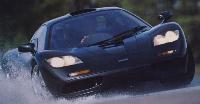

The Great McLaren F1The Story of The Great McLaren F1
The Race prepared version of this car, used in the Global GT Endurance Races, and LeMans are built in Surrey, England
What makes the McLaren F1 such a special car? Performance. No other road car accelerates as fast, no other road car has a maximum speed of well over 230 mph. It can outperform every other road car by a large margin. But there is much more to it. The McLaren F1 materialises the dream of a single man. Not just any man, but one of the most imaginative and successful engineers that Formula 1 racing has known.
Gordon Murray designed the Brabham-Alfa Romeo "fan" car that in 1978 won its first and only Grand Prix--then was immediately banned because it simply dwarfed the opposition. Murray was probably the first man to incorporate carbon fibre into the structure of Formula 1 cars, and he designed the world champion Brabham-BMW of 1983.
When he moved to McLaren, it was to design a sports car to beat the world, and he was given carte blanche by Mansour Ojeh and Ron Dennis to pursue the dream, regardless of cost. The target Murray set was that the car should be as compact as possible, yet practical, weigh no more than 1000 kg. (2205 lb.) dry and be powered by an atmospheric engine (for immediate response) developing at least 550 BHP.
At the time, McLaren was racing successfully with Honda engines, and it seemed logical to approach Honda for an engine meeting Murray's requirements. But the Japanese declined, feeling that they could not spare the capacity to develop such a project. So Murray then turned to BMW Motorsport and his old friend Paul Rosche, who had provided the engines to the Brabham team while Murray was in charge. Rosche enthusiastically accepted. Starting from a clean sheet of paper, Rosche and his team designed and developed a superb, all-aluminium 6.1-litre, 48-valve V-12, and it was a huge success right from the start. It immediately produced the required power and went on to develop as much as 627 BHP. Concurrently, the American Traction Company developed a fantastically compact transverse transaxle incorporating a differential with a 40-percent locking factor.
To reach his weight target, Murray had no choice as to the material to be used for the car's structure: It could be only carbon-fibre composites, mostly in the form of an aluminium honeycomb sandwich, while, wherever possible, the mechanical parts were made of aluminium and magnesium. There is hardly a component in the car that has not been specially designed for it, mostly to save weight. A typical example is the Kenwood CD stereo system. The unit proposed by the manufacturer weighed 37.5 lb. Murray said he would accept only half that weight. The company took on the challenge and eventually came up with a system even better than the original, weighing only 18.7 lb.
Finally, the car weighs 1100 kg. (2425 lb.) dry, and Gordon Murray's biggest disappointment is that he had to give up the idea of carbon brake discs, as used in racing cars. It proved impossible to make them grip sufficiently at low temperatures, especially in wet conditions. The switch to cast-iron discs cost him 39.7 lb. In the end, however, Rosche more than made up for the 220 lb. beyond the target weight by extracting some 75 BHP more from his engine than originally required by Murray.
Technical analysis
McLaren cars is divided into two small factories, each employing about 60 persons. One location is the office once occupied by designer John Barnard when he first worked for Ferrari. Located in Guildford, 28 miles South-West of London, it is now dedicated to the manufacture of the F1's monocoque body. It is an uncannily quiet place. No big (or small) presses shaping the structural or body components, but "tailors" manipulating patterns around which they cut carbon-fibre parts and bond them together or assemble aluminium and Nomex sandwiches. After assembly of the various parts in highly accurate jigs, the body structure is cured at 260 degrees Fahrenheit to become a very resistant survival cell. The front end of the body is a bolted, specially designed energy-absorbing structure, and the McLaren must be the only road-going car that survived a 30-mph barrier crash test without any structural damage--it could have been driven back to the factory after the test!
From the workshop, the body is sent to the best paint shop available, where the final layer is sprayed with a vinyl- based protective coat, which is peeled off just before the car is delivered. It then goes to a highly skilled upholstery shop (which also works for Rolls-Royce and Jaguar). McLaren insists on absolute regularity of the stitches and their alignment, and the workmanship is superb.
The finished body is then delivered to the assembly shop in Woking, where the management and technical offices are located. Assembly takes place in a single room that looks more like a living room than a workshop. Here, usually five cars in various stages of completion are lined up. High-quality carpets bearing a large McLaren script are provided for the workers where assembly work under the car is required. Huge front rubber mounts and rear extensions of the body structure support the engine and transaxle unit, the entire rear-double-wishbone-and-inboard-spring/shock unit suspension being pivoted on the transaxle, as in Formula 1. The front suspension is along similar lines, but mounts on an aluminium subframe. The aluminium shock absorbers are Bilsteins.
The engine and its carbon-fibre airbox are worth a good look before disappearing into the engine bay. Despite its huge capacity, the engine is only 23.6 in. long and weighs 586 lb. with all ancillaries. Magnesium castings are used for the dry sump, the cam carriers and covers, the oil pump and the housings for the variable intake camshaft timing control. Intake control is by 12 individual butterfly valves, and the exhaust piping is a real work of art. It delivers the exhaust gases to four highly heat-resistant Inconel catalysts, each with its own Lambda-Sond control, before they reach the huge and very effective muffler. The entire exhaust system doubles as a crushable structure in the case of a rear impact.
Though the car's general outlines were dictated by Gordon Murray, the detailed styling is the work of Peter Stevens, who managed to combine function with a highly attractive shape. Gordon insisted that the car should seat three abreast with the driver in the central position to provide a real Formula 1 feel, and the car was designed to provide moderate aerodynamic downforce. Downforce--provided it is properly balanced between front and rear--makes sure the car remains stable at high speeds.
The detail work shows just how much thought has gone into this car. Here are a few examples:
--The front suspension wishbones are pivoted, on either side, on a rigid subframe mounted to the aluminium-alloy front bulkhead by four rubber bushings that provide a fairly large amount of fore-and-aft compliance. But they are 25 times harder radially and are arranged in such a way that caster wind-off when braking is three to four times less than in other exotic sports cars. Braking at 1g, the caster angle is reduced by only 1.02 degrees.
--Whenever the brakes are applied, a small rear spoiler rises to move the centre of aerodynamic pressure rearward and compensate for the destabilising forward movement caused by brake dive. In its raised position, the spoiler also uncovers, on either side, a duct into which air is forced to cool the rear brakes. A switch on the dashboard enables the driver to raise the spoiler for extra rear grip if required--for example, at high speed in the wet.
--Most of the downforce is generated by ground effects obtained by a flat floor that terminates in a diffuser. To increase the "active" mass of air flowing under the car, two permanently running electric fans on either side of the car remove the boundary (slow-flowing) layer and discharge it into the engine compartment for cooling.
--The heat generated by the large engine and its catalytic exhaust system is a problem, and heat-isolating material is extensively used to protect the cockpit and various ancillaries. The efficiency of the insulating material has been increased by facing it with heat-reflecting material, the most efficient of which is gold. (Yes, gold as in Au.) This is quite extensively used, mainly in the engine compartment, at a cost of approximately $3500!
--The laminated windshield, specially developed by St. Gobain in Aachen, Germany, includes an efficient electrical heating system by a resistive plasma sprayed onto the inner face of the outside glass laminate. This treatment also reduces heat entry by 20 percent and ultraviolet light intrusion by 85 percent.
From the moment the finished body reaches the assembly shop, work proceeds without stress. Everyone is given the time to do his job properly. Assembly takes about 2250 man hours, and the target production of three cars per month will soon be reached. Every car is built to order, and McLaren says it has orders for one year's production.
Driving impressions
This car would be a force to reckon with at LeMans, so imagine driving it in urban traffic--rather awe-inspiring. But my confidence was immediately established by the engine's quite unexpected flexibility and docility, which came as a real surprise with 103 BHP per litre and no flywheel! True, the clutch pedal requires a good push, but the pick-up is quite progressive. On some occasions, though, some judder was experienced. While the driver's seat was comfortable, the driving position was not ideal for me, and I had to compromise between having the pedals too far away or the steering wheel too near. But both the pedals and the steering wheel can be adjusted for reach, according to the owner's requirement.
Thanks to the central driving position, the pedals are perfectly in line with the driver's seat and the steering wheel. Together with the fully visible front fenders, it is very easy to accurately place the car. When overtaking, however, it means pulling out slightly more before oncoming traffic becomes visible. The two passenger seats are quite comfortable and because they are offset to the rear of the central seat, the front wheel arches do not intrude into the passengers' foot space.
For driving pleasure, the central driving position is ideal, though entry and exit require both agility and some practice. In fact, two pages of the beautiful owner's handbook are dedicated to the right technique. Driving in traffic also highlighted the--by supercar standards--unusually good all-round outward vision, especially the three-quarter rear, most supercars' Achilles' heel.
Two inside and two outside mirrors provide a fairly good rear view. Only backing up creates problems because the air duct to the engine intake obscures the centre line. Forward views are outstanding, the width of the car being well defined by the bulging front fenders. The car's docility in traffic is spoiled only by the insufficiently progressive accelerator control in the very first part of its travel, which requires a fair amount of finesse to achieve smoothness. Even at higher rates of speed, this could cause some problems in the wet with so many horses to control.
Slow traffic, however, is not what the McLaren has been designed for. Its natural element is the open road, and here its performance and general ability simply defy imagination. If you think the latest Porsche Turbo 3.6 is a quick car, the McLaren will tell you a different story. From rest, the Porsche reaches 100 mph in 10.1 seconds; the McLaren takes only 6.3. The quarter mile takes the Porsche 12.9 sec.; the McLaren a stunning 11.1 sec. It is the only road car that can crack 20 sec. over the standing kilometre--19.6 sec.--beating its nearest rival, the Jaguar XJ220, by a full second and the Porsche by 2.9.
It is not only the sheer performance that makes driving the McLaren so fascinating, it is the way the car achieves it. The BMW "M" engine's maximum torque of 500 lb.-ft. is impressive enough, but from 4000 to 7000 rpm the torque remains above 479 lb.-ft., and even at only 1500 rpm it reaches 400. So even in a high gear, the McLaren can out-accelerate almost anything on the road, and with those 12 throttle valves located only a few inches from the intake ports, you always get instant response. Even on country roads, 6th gear can be used quite often--which certainly helps fuel economy--even if it does not really come naturally.
When you're cruising at more or less legal European motorway speeds, the mechanical noise remains very subdued, but shift down, floor the throttle, and the car is catapulted forward to highly illegal speeds to the accompaniment of noise comparable to a Concorde taking off, which remains completely unnoticed by outsiders--so well is the exhaust silenced. Using the performance is encouraged by the slightly notchy, but quick and precise, gearshift, and the pedals are perfectly aligned for easy heel-and-toeing.
The huge Brembo brakes make full use of the magnesium wheels' 17-in. diameter and are fully up to the car's performance. The absence of both a booster and ABS is mainly to save weight, but also in consideration of the F1's character. The brake pedal has hardly more than an inch of travel, which make the brakes beautifully progressive, but maximum retardation requires a heavy foot.
Fortunately, the Silverstone circuit provided an occasion to investigate the handling more thoroughly than was possible on public roads. Though the McLaren achieves cornering speeds probably higher than any road car, it cannot achieve cornering speeds as high as full-blooded racing cars benefiting from racing tires and strong downforce. Such speeds would be completely out of place on public roads anyway, but the F1's cornering behaviour is very similar to a racing car's. Cornering at 0.5-0.6g, there is quite noticeable understeer, probably induced by the 40-percent limited-slip differential, but the higher the speed, the more neutral the car feels. The attitude is readily adjustable by the amount of throttle given. Reducing the throttle opening will make the car tighten its line and, if you are in the right gear, it can be nicely drifted out of the bend. Stability under braking is excellent, even if the brakes are still applied when going into the corner. Straight-line stability at speed is equally creditable, even on indifferent surfaces, and in spite of the wide tires, wander was never a problem.
When cornering fast, the extremely accurate steering requires a bit of muscle to hold the cornering line. In the interest of better feel and lower weight, Murray opted for non-assisted steering, but there are some modern systems that preserve an excellent feel and are quite light; the Honda NSX's electric device is a good example. To compensate for the extra weight, I would easily forsake the F1's sound system: Good as it is, it is of little use in such a car where the music is dwarfed by either engine or road noise.
Road noise is fairly prominent in the F1 when cruising at part throttle. Much of this is said to be caused by resonance in a box section housing the steering rack; it's now being dealt with by adding some foam material. On the other hand, bump impacts as caused by concrete joints are fairly well damped, and suspension comfort generally is exceptionally good for such a fast and sporting car. And for all its lightness, the structure is obviously immensely tough and rigid--an essential requirement for good handling and long life.
It may sound absurd to spend a million dollars on a car, and it can never be justified on practical grounds. But if price is irrelevant, the McLaren offers engineering and workmanship second to none and performance never attained before in a road car.
T
ech Spec.Curb weight - 1100 kg
Wheelbase - 107.0 in.
Track, f/r - 61.7 in./57.9 in.
Length - 168.8 in. (4920 mm)
Width - 71.6 in. (1920 mm)
Height - 44.9 in.
Accommodation - 3, central driving positionENGINE & DRIVETRAIN
Type - dohc 48-Valve V12
Displacement - 6064 cc
Bore x stroke - 86.0 x 87.0 mm
Compression ratio - 10.5:1
Power - 627 BHP @ 7400 rpm
Torque - 500 lb-ft @ 5600 rpm
Transmission - 6-speed manual
Gears
1st - 3.23:1 - 7.66:1
2nd - 2.19:1 - 5.19:1
3rd - 1.71:1 - 4.05:1
4th - 1.39:1 - 3.29:1
5th - 1.16:1 - 2.75:1
6th - 0.93:1 - 2.20:1
Final drive ratio - 2.37:1CHASSIS & BODY
Layout - mid engine/rear drive
Body/frame - carbon fibre/carbon fibre-aluminium honeycomb monocoque
Brakes, f/r - 13.1-in. vented discs/12.0-in. vented discs
Assist type - none
Wheels - alloy; 17 x 9 f, 17 x 11-1/2 r
Tires - Goodyear run-flats; 235/45ZR-17 f, 315/45ZR-17 r
Steering - rack & pinion, unassisted
Suspension
Front - unequal-length A-arms, coil springs, tube shocks, anti-roll bar
Rear - same as front
TOP SPEED: 237 MPH, THIS IS THE FASTEST ROAD CAR IN THE WORLD!
0-60: 3.2 secs
0-100: 6.3 secs
Quater Mile: 11.1 secs
1 Kilometre: under 20 secs
price tag: £634,000